

A persistent central theme of Quranic narratives regarding historical events revolves around observing and studying the fallen nations, the civilisations of the past and their architectural ruins are framed as objects for societal self-reflection, acting as relics that symbolise the temporality and fragility of human might and glory.
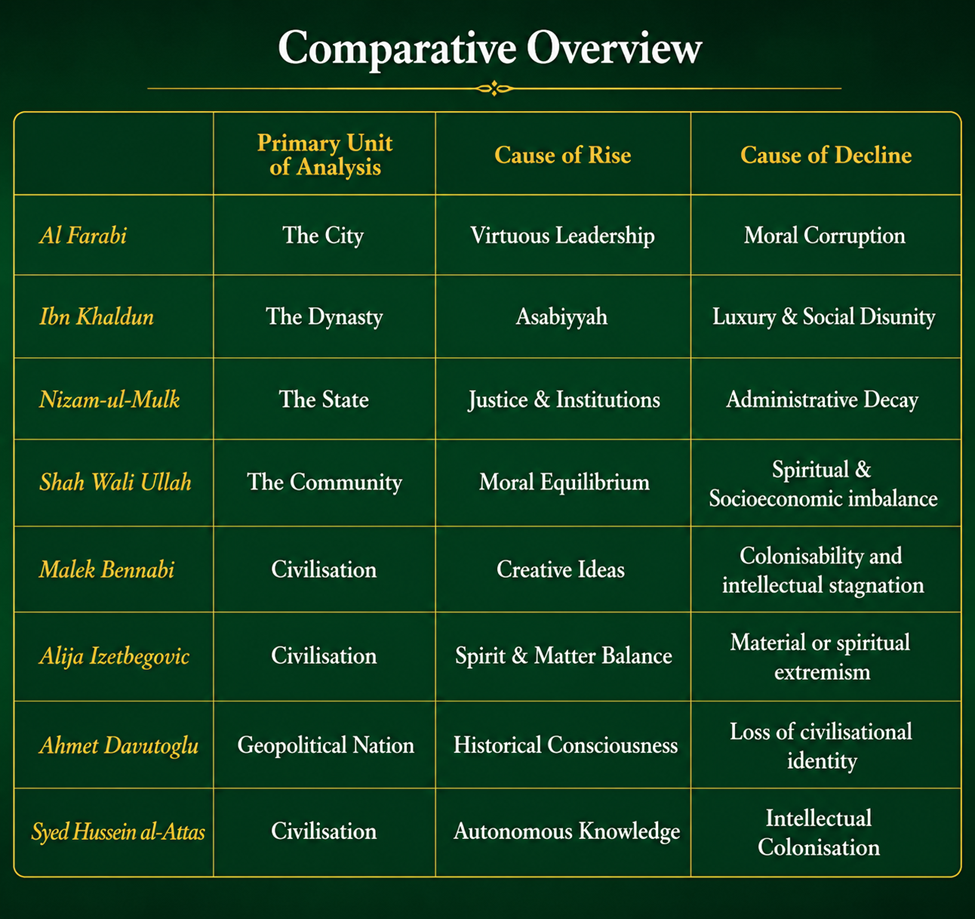
This post briefly overviews how the major muslim political theorists, classical and modern have developed islamic theories of civilisational cycles within their sociopolitical distinct contexts, addressing primarily the elements that drive societies to success and the factors which disturb its flow and cause eventual civilisational decline. Since not every thinker explored here has written particularly and definitely on civilisational cyclical discourse, their ideas and frameworks on politics, leadership and governance have been extended to shed light on what their cyclical theories would be like.
Al-Farabi: The Virtuous City
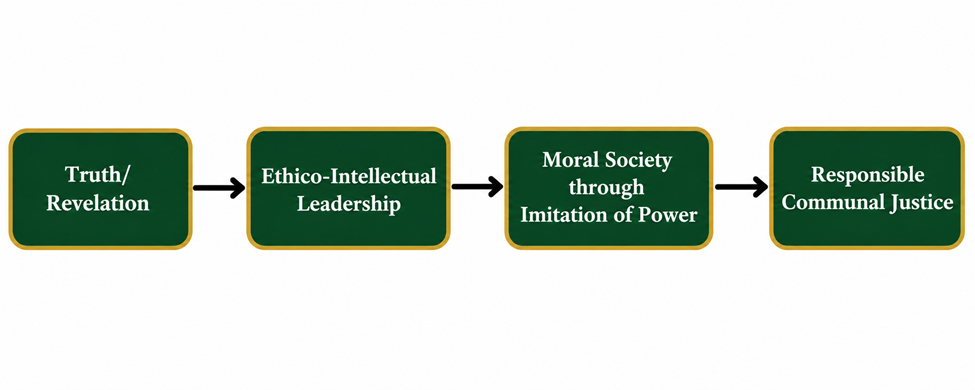
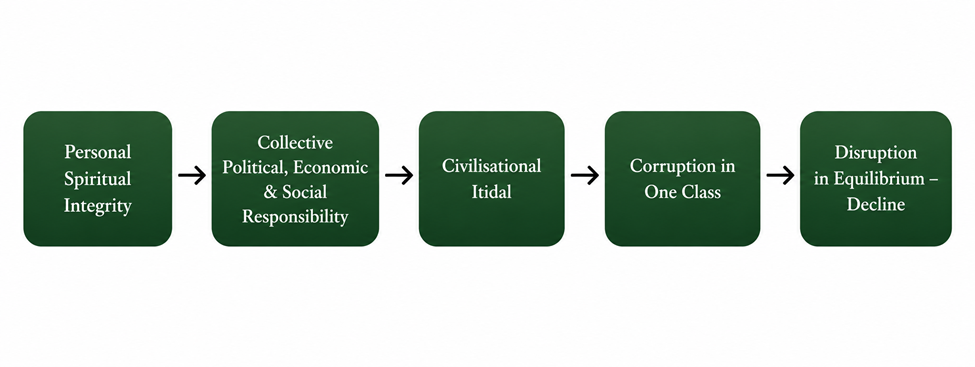
Success at the civilisational scale emanates only from the ethico-intellectual perfection of man as a single microcosm. The purpose of collective hierarchical political organisation is not merely to maintain order but to cultivate virtue, the criteria of success for a civilisation is through how much it directs its individual agents toward their ultimate purpose – just modes of intellection.
Just as the organs of the body function harmoniously under the guidance of the heart, society requires a philosopher-prophet or virtuous ruler who aligns political lite with transcendent truth. Civilisations prosper when they act as a collective educational ecosystem – always aiming for pursuits of aligning ethical characters and philosophical-scientific temperament in political life having internal and external economies of justice as the central guiding forces.
The purpose of collective hierarchical political organisation is not merely to maintain order but to cultivate virtue
Decline occurs when societies abandon immaterial higher ends and reduce politics to material desires, power struggles and collective appetites – the corruptive seed for civilisation gets planted at the top, corruption begins from the top and spreads downward. Rulers who don’t value ethico-intellectualism and prioritise power over virtue end up creating an unstable society where each agent develops misplaced priorities and all aim for hollow materialistic power, and a social survivalist insecurity is born amongst communities and thus civilisational disintegration. The central pivot holding societies together have to be certain immaterial ideals, and especially correct ones for true success.
Nizam-ul-Mulk: Circle of ‘Institutional’ Justice
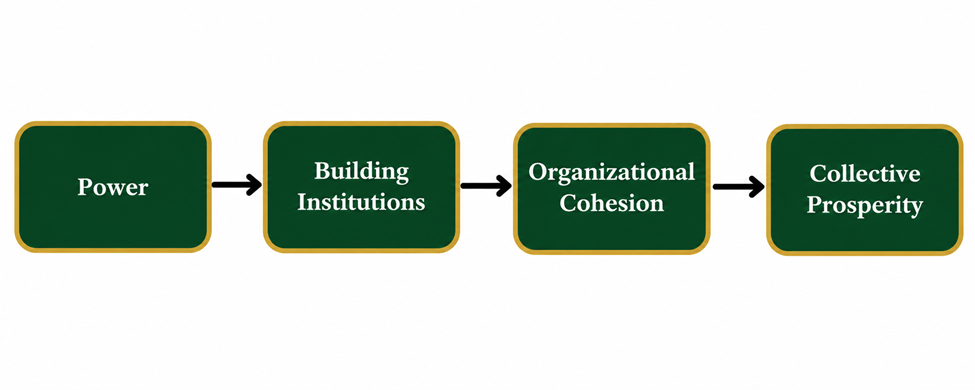
Working through the inherited logics of persian political maxims, the seljuk vizier emphasised the unity of various state institutions. Civilizations endure through the strict maintenance of administrative institutions and responsible organisational corperation between ruler, army, treasury and people.
The smooth operations of political order precede all higher philosophical and intellectual pursuits – without justice and administration, neither religion nor prosperity can survive – civilisations and all their social values & cultural traditions strive under a centralised order of power that governs and maintains a balance between all the elements of triction amongst various communities. A successful polity here is the one that behaves as an interconnected organism whose elements revolving around the sultanic power, sustain one another.
The smooth operations of political order precede all higher philosophical and intellectual pursuits – without justice and administration, neither religion nor prosperity can survive
Where ibn khaldun places social cohesion (asabiyyah) at the central stage in civilisational rise and decay, nizam ul mulk attaches that significance to administrative cohesion between different operational units of a polity, every ideological, religious, philosophical tenet of a civilisation then affects its destiny pragmatically only as much as it operates institutionally and functions in an organised form of governance with administrative cohesion.
The civilisation decays when its organisational cohesion is lost and each administrative pillar starts operating independently.
Ibn Khaldun: The Cycle of Asabiyyah
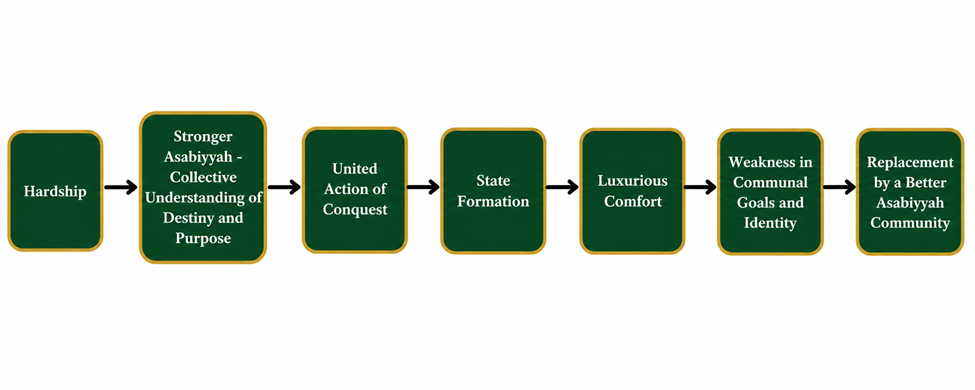
History unfolds according to the strength and eventual decay of socio-communal solidarity i.e. asabiyyah – the internal cohesion of a community in terms of its understanding of its identity, collective destiny and consequently collective action.
Luxury weakens collective spirit, instead of communal goals, private ascent in status and comfort gets prioritised in times of ease, thus opening doors to being replaced by newer groups
Hard times produce social unity in dealing with the problem with collective cohesive empathy, which helps create united methods and strategies of conquest, conquest establishes dynasties, however prosperity and particularly attachment to material luxuries gradually erodes the very virtues that fuelled the success. Luxury weakens collective spirit, instead of communal goals, private ascent in status and comfort gets prioritised in times of ease, thus opening doors to being replaced by newer groups from the periphery with greater intensities of asabiyyah and collective hunger + action for socio-economic development.
Instead of ideological explanations for civilisational rise and fall, Ibn Khaldun offers a sociological explanation where civilizations do not merely erode because they become unethical, immorality doesn’t itself necessitate political disorder, the disintegration of social cohesion that comes with success itself contains the seeds of decay – losing the sight and control of a collective understanding of identity and purpose due to immersion in the comforts of success generates the civilisational decline.
Shah Wali Ullah: Civilisational Ethical Equilibrium
Societies evolve simulations at various distinct stages of development – irtifaq – from basic necessities like food & shelter to then transactional exchanges and market cooperation to the formal governmental laws and policy for regulating the communal cooperation and ultimately an international order for inter-state cooperation.
The integral most component in these stages of irtifaq being an equilibrium between all the classes of polity dedicated to each of these departments; a civilisation’s prosperity depends equally on each of the different classes of society, and particularly a disturbance of balance in power and influence amongst the various socio-economic and spiritual communities causes civilisational disruption.
When one particular class whether the political, or the trading or the religious, gain an irregular share in the economies of influence and become exploitative against the other classes, the society loses its itidal and thus decline. An equilibrium has to be maintained, all should work interdependently with internal spiritual integrity to restrict a socio-economic overreach by any specific group, a harmony of the economies of influence is what makes or breaks dynasties.
Alija Izetbegovic: Spiritualism & Materialism
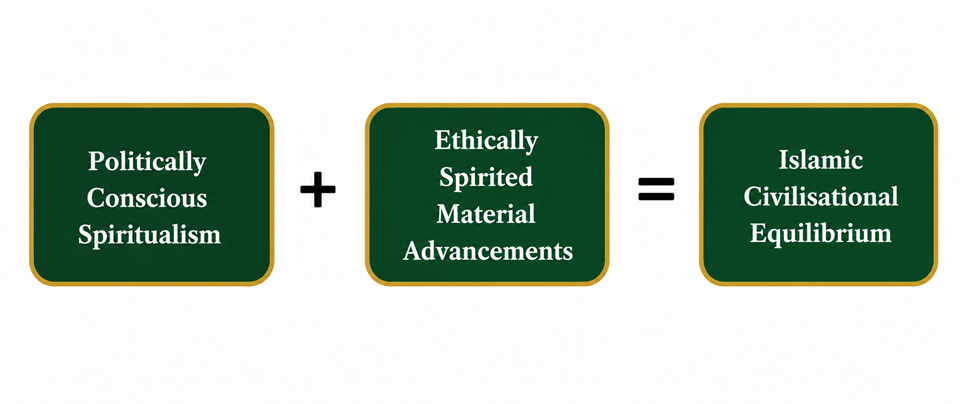
Civilisations succeed islamically when they achieve a sweet harmony between the spiritual meaning and the material development – the recipe is spiritually aligned individuals, who position themselves cosmologically first and then govern the material socio-economic relations with the world.
Hollow socioeconomic growth and technological advancements would only bore cultures of communal hedonism or nihilistic oppressive politics that value nothing but power for egoism – chaotic technological advancements without any moral reformative technologies of the self would only create nimrods and firawns rather than a sulayman.
Hollow socioeconomic growth and technological advancements would only bore cultures of communal hedonism or nihilistic oppressive politics that value nothing but power for egoism
On the other hand, purely passive spiritualism is a trickery of the devil, and a path away from prophetic moderation and quranic civilisational duties in the world for muslims, and such apolitical spirituality is always at the mercy of disingenuous amoral political agents. A synthesis between action and contemplation, temporal and the akhirah, mosque and the parliament, dargah and the marketplace is required to preserve the equilibrium for the sustenance and (worldly decline.: eternal) prosperity of the muslim civilisation: ummah.
Malek Bennabi: Civilisational equation & colonalisability
Working in the context of modern decolonisation theory, civilisations diminish internally before being conquered by external forces, and the former is essentially the cause for the latter. The conqueror only succeeds when a society itself becomes colonisable – gabiliyyat lil-isti mãr – when it loses its ideological sovereignty and eventually the originality and strength of its socio-political institutions and turns complacent to invite foreign intervention – colonisation only occurs by the psychological/ideological colonisable receptivity of the conquered.
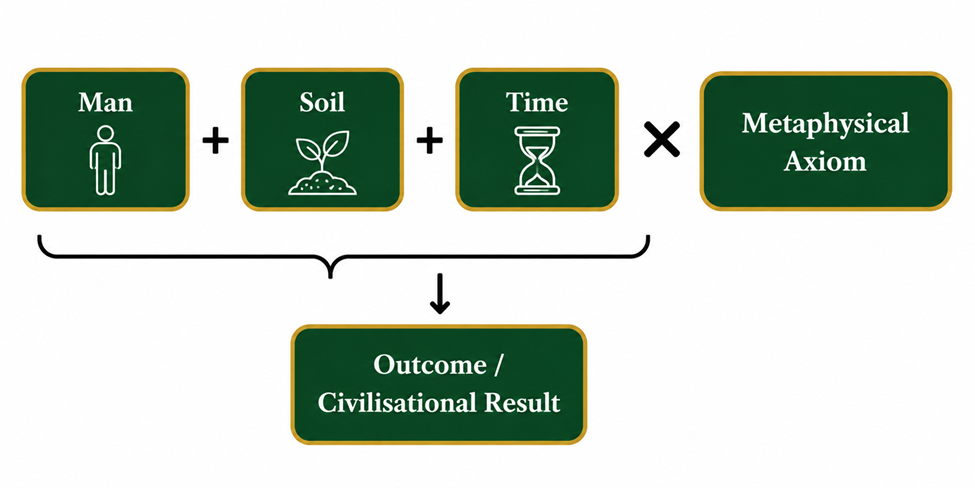
A weakness in the network of ideas and their original generation by a community is the primary cause of tailing to defend against foreign powers even while having better military prowess. And to guard against falling into such internal collapse, bennabi provides the equation of man + soil + time + metaphysical guiding axioms – where the human mind (religious-psychological orientations), its connection with their land (its geopolitical conundrums and natural resources) and the flow of time & duration that are required to develop something with the connection, all can only be guided by the catalyst i.e. the metaphysical axiom (fikre diniyya), what orientation should man have for the world, for what purpose should his land and its dynamics be used and where exactly should he envision his shared nation over a period of time, to generate an original doctrine of one’s own civilisation, the worldview has to be clearly defined by transcendent principles, which would then guide the geopolitical dimensions of communal life and eventually define a central idea of a collective destiny – which eventually would act as the reason to revolt against foreign ideological and political interventions.
Only a clear understanding of civilisational essence and destiny from primary religio-ideological foundations would fuel the man to work against all types of colonisations and disruptions and focus on building his native existential theories of political being, rooted in his own geography and religio-psychological orientations.
Ahmet Davutoglu: Strategic Historical Consciousness
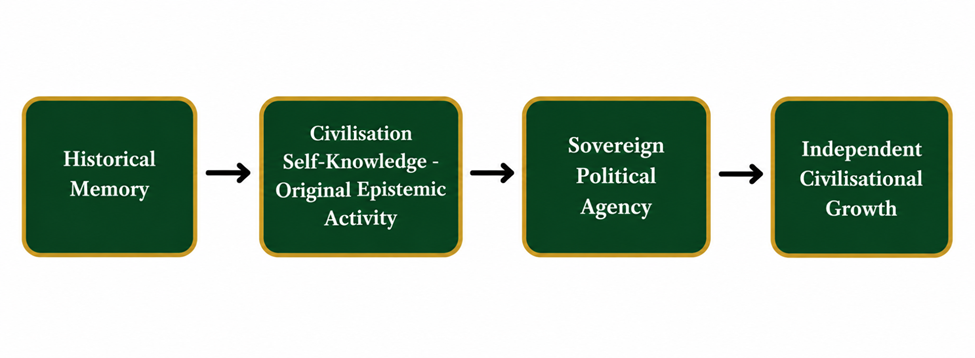
To endure, civilisations need conscious continuity of historical memory and geopolitical self-identity, each society has to configure their future pathways on the patterns of their practiced and tested historical successes. Civilisations compete with each other not only in geographical space but the logics of legitimacy and the projection of identity and meaning on that space – material power, resources and their usages are driven by the narratives attached to them, which are themselves built through internal epistemology and ontology of communities – the frameworks through which a civilisation views existence, human nature, knowledge and meaning, all create the culture that gives a nation its identity.
To guide your society by importing foreign epistemic knowledge structures, and enforcing them onto incompatible geopolitical historical memories and self-consciousness would never be of any help, to perceive yourself by categories of the rival civilisation (developed in their particular historical memory, epistemic orientations and geopolitical genealogies) would only form a chimera of corruptive socio-political networks all in tension with each other.
Societies collapse by internalising narratives not their own and hence losing epistemic agency in defining their destiny, so in order to behave as independent and sovereign political actors, nations must theorise in their own epistemic ways and through the inheritance of their own historical self-consciousness – only a strategic posturing in such a manner can create internally and externally cohesive systems of government.
Syed Hussein al-Attas: Autonomous Knowledge
Colonialism and especially cultural imperialism manufactures myths and imparts them educationally onto the colonised to blur their own educational autonomy over knowledge and intellection – installation of psychological inferiority through false narrative of indigenous irrationality and backwardness, colonial powers violates the epistemic paradigms of nations, where they become unable to even critique the foreign oppression in their own grammar – where the very efforts to escape the imperial cage end up legitimising its existence.
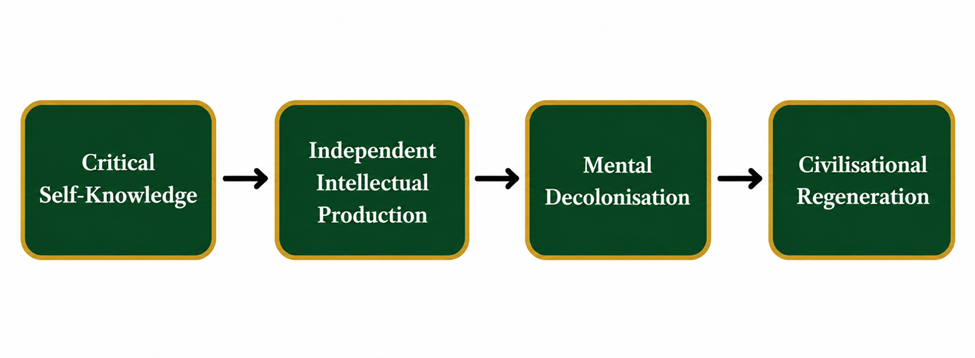
The key to kickstart such renewal is with the intellectual elite of the nation, who have to resist the temptations of glorified colonial epistemologies
For any society to revive itself, it has to reconstruct its educational (knowledge) . autonomy and culture of indigenous socio-political development have to follow liberated indigenous traditions of thought. And the key to kickstart such renewal is with the intellectual elite of the nation, who have to resist the temptations of glorified colonial epistemologies and counter the myths being enforced on the laity about themselves by understanding the sociology of colonial knowledge and the exploitation of local psyches. Civilisations only grow and die based on their knowledge autonomy, how a single agent of a nation perceives himself and the independence of his self-perception is exactly where the destiny of a civilisation lies.