



Why building beats knowing, and how the craft is actually learned
Every field distinguishes, sooner or later, between the person who understands a thing and the person who can do it. A man may read every treatise on carpentry and still not be able to cut a joint. Skillcraft exists for the second kind of person, the one who wants to build, ship, and improve rather than merely accumulate opinions about building. In an age crowded with commentary on artificial intelligence and fragmented attention, the people who matter are not the ones with the most informed view of where things are heading. They are the ones already turning an idea into a working thing and placing it before the world. That is the discipline this domain trains, and it begins, as every craft has always begun, with a change in what a person considers himself to be.
Leaving the Audience
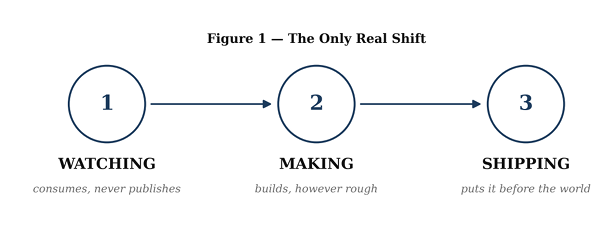
The first task is leaving the audience. A person can spend years consuming lessons on a subject and never once have produced anything of his own, in the same way that attendance at a gathering does not by itself change a man’s character. Skillcraft asks for the opposite posture: build something, however rough, and put it in front of people who can judge it. The obstacle here is rarely technical; it is psychological friction, the habit of measuring one’s own life against other people’s finished wins while contributing nothing of one’s own. Waiting for perfection, an expensive setup, or a decade of mastery before sharing anything is not humility. It is a delay dressed up as discipline. A person does not need to have mastered a subject to be useful to someone one step behind him; helping another person improve by even a small margin is itself a legitimate form of value, and teaching what one is actively learning today is often more honest than pretending to have arrived. None of this requires a camera-ready personality either. Screen recordings, tutorials, animated storytelling, and curated value accounts build real audiences without a single face ever appearing on screen.
What a Builder Actually Offers
At the centre of every skill worth building lies a plain fact: a person is, in the end, offering his own knowledge and experience, not a generic service copied from someone else’s template. A mother who has raised children has something to teach other mothers. A person who has learned to manage his own anger has something to offer someone still learning the same discipline. The instinct to wait until one feels sufficiently qualified is usually a disguise for fear, and it costs more than it protects, because the audience that needed the lesson three years ago has already found it elsewhere. Skillcraft treats lived competence, however modest, as a legitimate starting point, provided the person is honest about where he stands on the path.
Choosing Where to Stand
Generality is the quiet killer of most first attempts. ‘Parenting’ teaches nothing to no one in particular. ‘Managing sleep schedules for first-time mothers’ teaches something specific to someone specific, and specificity is what earns attention in a market already flooded with generalities. The same discipline applies to platform choice. Many builders burn out within two months not because their work lacked merit but because they tried to conquer every platform at once. The wiser course is to identify where one’s actual audience already spends its time, long-form search intent on YouTube, short-form visual authority on Instagram, professional credibility on LinkedIn, and master that single channel before ever attempting to cross-post. Depth on one platform outperforms a thin presence spread across five.
The Work Before the Work
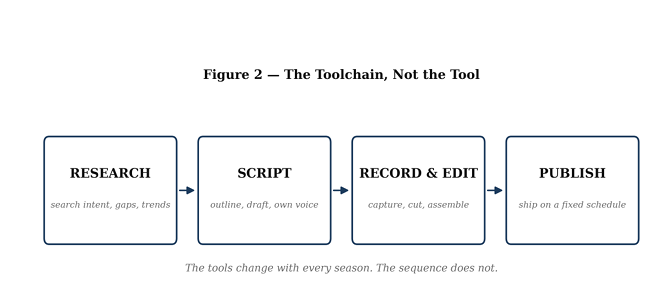
None of this is guesswork dressed up as instinct. Before a single piece of work is produced, the serious craftsman studies where the real questions already live: the searches people type, the discussions in forums and groups, the gaps competitors have left unaddressed. Tools built for exactly this purpose, ones that map search intent directly and confirm whether interest in a subject is actually rising, remove the need to guess at demand. Five well-chosen points of comparison teach more than fifty scattered ones, and studying creators a step or two ahead, the ones with ten to fifty thousand followers who are visibly still climbing, teaches more than studying the outlier at the very top of a field whose scale and resources cannot be replicated.
What the Tools Are For
A craftsman is still judged by what he makes, not by the tools on his bench, but the right tools shorten the distance between idea and finished work considerably. A document-grounded research tool that synthesises a person’s own sources rather than inventing from nothing keeps early research honest. Conversational assistants are useful for generating an initial list of topics and rough script outlines, provided the final voice remains the builder’s own. Voice-generation tools now offer a level of control that makes recorded narration accessible to someone who never intended to appear on camera at all, and mobile editing tools have made the physical assembly of a finished video, trimming, pacing, cleanup, achievable without a studio. None of these tools replace the builder. They simply remove the excuses that once stood between an idea and its shipped form.
An Audience That Trusts You
A subscriber count is a number. A community is a relationship, and relationships are built the same way whether they exist online or across a mosque courtyard: through service rendered before anything is asked in return. In a landscape crowded with automated content, the presence of an actual human being who replies to comments, asks his audience what it actually needs, and hosts a space where people can grow without fear of ridicule becomes a genuine point of difference rather than a courtesy. Giving away the best of what one knows, without an immediate return attached, is what earns the long-term authority that a paid offering later depends on. The company a builder keeps online matters as much as the content he produces; engaging seriously with peers and creators a step ahead builds a professional network that no algorithm can substitute for.
The First Hundred Attempts
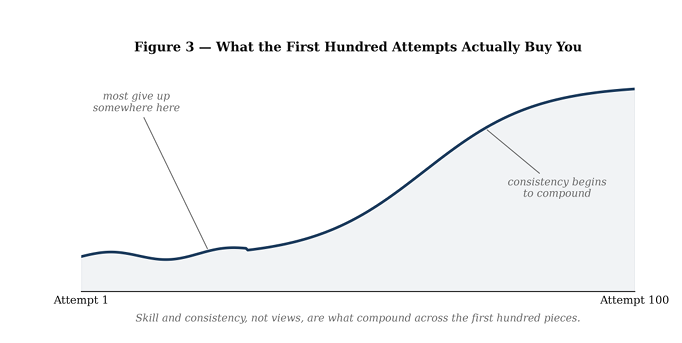
There is an old principle in every craft tradition: the first hundred pieces are for learning, not for selling. A calligrapher does not frame his first hundred lines of practice, and a builder should not expect his first hundred pieces of work to build an audience. Their purpose is to teach the hand and the eye what the mind cannot learn by reading about it. A video sitting at a hundred or two hundred views in the early months is not a sign of failure; it is the normal condition of apprenticeship, and the correct response is to run small experiments, on a title, a thumbnail, a pace, rather than to abandon the craft. Search and recommendation systems reward what they can predict, and what they can predict is a builder who shows up on a reliable schedule. Consistency, not a single fortunate result, is what eventually earns both algorithmic trust and an audience’s habit.
Where to Begin
None of this requires an expensive camera, a costly subscription, or anyone’s permission. What it requires is a single problem the builder already knows how to solve, or is honestly still learning to solve, carried through the discipline described here and shipped into the world in its first, imperfect form. Commitment is the bridge between wanting this work and actually doing it. Everything else, research, consistency, community, patience, is downstream of that single decision, made and renewed daily, to treat the craft as a discipline rather than a performance