


Why prompting, automation and agentic systems reward the practitioner, not the spectator
Most people meet artificial intelligence the same way. They type a loose sentence into a chat window, receive an answer that is roughly right and slightly generic, and close the tab having settled what the technology is worth. That first impression, formed in under a minute, becomes a permanent opinion. The practitioner meets the same tool differently. He treats the first answer as feedback on his instruction rather than a verdict on the machine, and he goes back in. From that second attempt the path runs through prompt design, workflow automation and agentic systems, each step handing more of the routine to the machine while the judgment stays with the person.
From Spectator to Operator
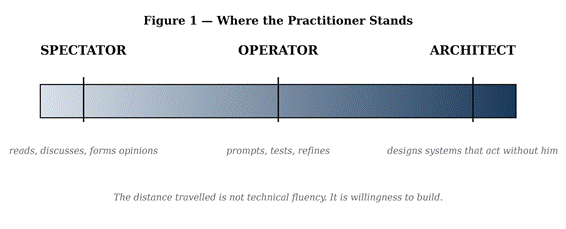
A person can read a hundred articles about large language models and still be unable to get one to do useful work. Reading builds vocabulary. Only operating a tool builds judgment. The discomfort of a first attempt, a prompt that returns nonsense, an automation that fires at the wrong moment, an agent that takes the wrong action, is not evidence that the tools are unready. It is the same discomfort every apprentice feels the first time a machine does not do what he expected, and it is resolved the same way it has always been resolved: by staying at the bench and trying again. The practitioner does not wait to feel expert before beginning. He treats the first hundred prompts the way any craftsman treats his first hundred attempts, as tuition rather than performance.
The Craft of the Prompt
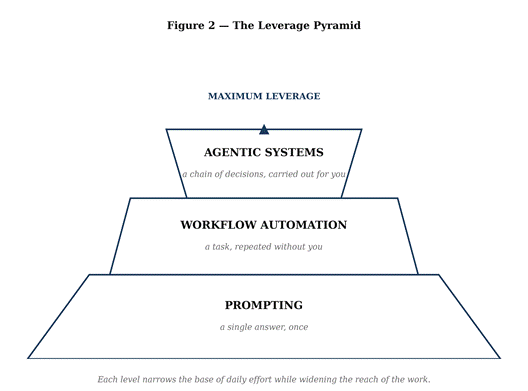
A prompt is not a search query, and treating it like one is the single most common reason people conclude that a tool has failed them. A search query retrieves what already exists. A prompt specifies a task, a constraint, a voice, and a standard of output, and the quality of what returns is almost always a direct reflection of the quality of what was asked. Learning to state an objective precisely, to supply the context a model actually needs rather than the context that feels natural to a human reader, and to iterate on a failed attempt rather than abandon it, is a discrete skill with its own discipline. It rewards the same patience that any craft rewards. A vague instruction produces a vague result regardless of how capable the underlying model is, in the same way that a vague brief to a skilled tradesman produces work that technically satisfies the brief and serves no one.
Automation as Compounding Work
A prompt, however well written, is answered once and then it is gone. Automation is what happens when a person stops asking the same question every day and instead builds a workflow that asks it for him. The distinction matters more than it first appears. A single well-crafted prompt saves a person minutes. A workflow that captures a task, routes it correctly, and executes it without supervision saves those same minutes every single day it runs, and the saving compounds in a way a one-off answer never can. The practitioner’s instinct is to notice which tasks repeat, research summaries, data cleanup, first-draft replies, scheduling, and to build the workflow once rather than perform the task again by hand. This is unglamorous work, closer to plumbing than to spectacle, and it is precisely the work that produces leverage rather than novelty.
Agents That Act, Not Just Answer
An agentic system goes further still. Where a workflow executes a fixed sequence a person has already designed, an agent is handed an objective and a set of tools and left to determine the sequence itself, checking its own progress, adjusting when a step fails, and continuing toward the goal with a degree of autonomy no earlier tool possessed. This is not a small technical distinction. It is the difference between owning a tool that answers when asked and owning a system that keeps working while its owner is doing something else entirely. Responsible use of this capability demands more supervision, not less. An agent still needs a clearly bounded objective, a defined scope of authority, and a human who checks its output before it is allowed to touch anything consequential. Leverage of this kind is earned by the practitioner who has already mastered the prompt and the workflow beneath it. It is not a shortcut available to someone who has skipped those stages.
Leverage Over Novelty
The market for artificial intelligence tools changes every few weeks, and the temptation to chase each new release is constant. A practitioner who adopts a new platform every month never gets far enough into any one of them to build something that actually compounds. The wiser course is the same one every craft has always demanded: choose a small set of tools, understand their limits precisely, and spend the time that would have gone toward exploring alternatives on building something that keeps producing value after the initial excitement fades. Leverage is measured by what continues working without you, not by how many tools sit unused on a shelf.
Where to Begin
None of this requires access to the most advanced model available or a technical background in engineering. It requires a single repeated task worth automating, or a single decision worth handing to a well-scoped agent, carried through the discipline described here rather than left as an idea discussed but never built. Commitment is the bridge between watching a demonstration and owning a system of one’s own. Everything else, better prompts, cleaner workflows, wider agentic authority, is downstream of that first decision to stop spectating and start operating.