



Why the useful question is never “which AI tool is best” but “which stage am I stuck at”
A content calendar can stall in five different places, and each one needs a different kind of help. Sometimes nothing worth saying has come to mind. Sometimes the idea is clear but the draft will not come, or the words are ready and the graphic is missing, or the video is recorded and no one sees it. Artificial intelligence now offers help at every one of these points, which is exactly why so many people end up confused by it. They reach for a single tool and expect it to fix a problem it was never built for. The useful habit is to name the stage where the work has stopped before opening any tool.
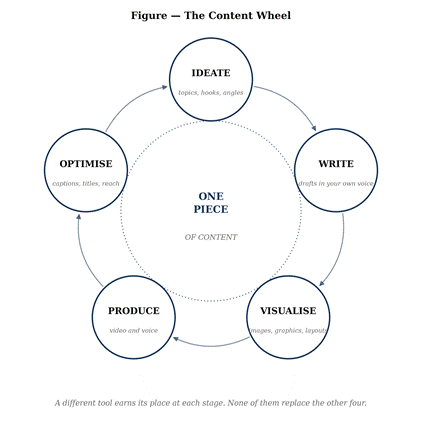
Ideation Is Not the Same Task as Writing
The blank page has always been the first obstacle, and it is the one artificial intelligence removes most reliably. Asked well, a language model can produce thirty rough angles on a subject in the time it takes to make tea, and the practitioner’s job is not to accept the first idea offered but to treat the list as raw material, discarding most of it and combining the rest into something sharper than any single suggestion. This is a different skill from writing itself. A person who is good at generating angles is not automatically good at developing one into a finished piece, and conflating the two stages is why so many people mistake a long list of AI-generated ideas for a finished content calendar. It is neither. It is the starting material for one.
Writing That Still Sounds Like Someone
A first draft assisted by a language model saves real time, provided the practitioner treats it as scaffolding rather than a finished piece. The most common failure at this stage is publishing the draft exactly as generated, in a voice that sounds like every other account using the same tool the same way. The corrective is simple and unglamorous: read the draft aloud, cut whatever a real person would never actually say, and rewrite the opening and closing lines by hand, since those are the lines an audience remembers. A model can supply structure and momentum. Only the person behind the account can supply the specific texture that makes an audience trust one voice over another.
Visuals Without a Design Background
Image generation has done for visual content what basic writing assistance did for text: it has removed the excuse of no design background as a reason not to publish. A creator with no training in graphic design can now produce a passable thumbnail, a branded template, or a clean carousel slide, and iterate on it in minutes rather than commissioning it and waiting days. The caution here is consistency, not capability. A feed where every image looks like it came from a different hand reads as amateur regardless of how good any single image is. The practitioner picks a visual style early, a palette, a typeface, a mood, and holds every generated image to that standard rather than treating each one as a fresh experiment.
Video and Voice, Without a Studio
The stage that once required the most equipment now requires the least. Text-to-speech tools capable of natural, emotionally controlled narration mean a faceless channel is no longer a compromise; it is a legitimate format chosen on purpose. Editing tools built for a phone can assemble, trim, and caption a video that once needed a desktop suite and a trained editor. None of this replaces a point of view. A well-produced video with nothing to say still fails, and a rough video with something genuinely useful to say still finds its audience. Production quality is the floor a piece must clear, not the reason anyone stays to watch it.
Optimising for the Reach a Piece Deserves
A finished piece that nobody finds has still, in the way that matters, not been finished. The last stage, writing a title that earns a click without misleading, choosing the caption language a platform’s search actually responds to, timing a post for when the intended audience is present, is where a great deal of good content quietly dies from neglect. Tools built specifically for this stage can surface what an audience is actually searching for and how a title is likely to perform before it is ever published, replacing guesswork with evidence. Skipping this stage after investing real effort in the first four is the single most avoidable mistake a practitioner can make.
Where to Begin
None of this requires assembling the largest possible toolkit before starting. It requires identifying, honestly, which of the five stages is currently the bottleneck, ideation, writing, visuals, production, or reach, and adopting one tool suited to that stage before moving on to the next. A creator who fixes one real bottleneck this month has done more for his output than one who tries every new tool released and finishes none of the work. The wheel keeps turning regardless. The only question worth asking is where it currently stalls.