

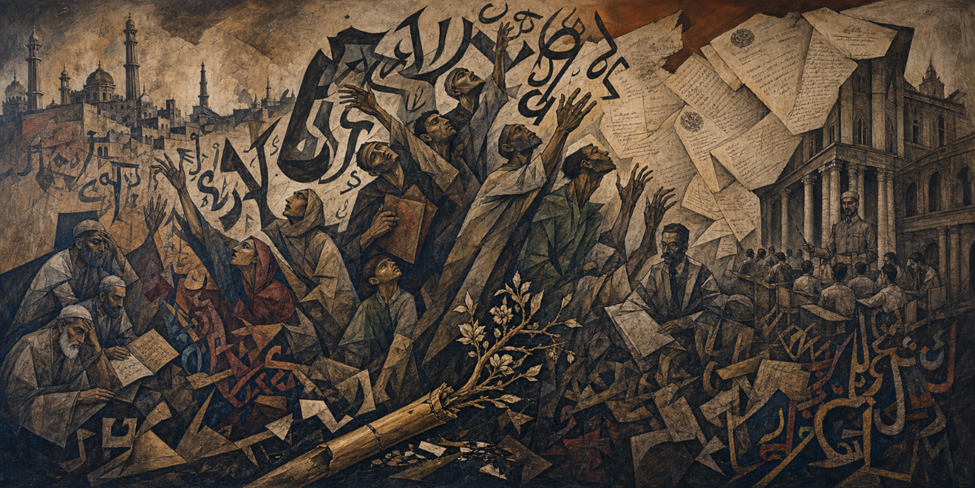

There is a convenient fiction that languages are merely instruments: one uses English for business, Urdu for daily conversation, Arabic for prayer, and Persian for poetry perhaps. According to this, changing languages is rather like changing pens. The thought is comforting, but it is false.
A language does more than enabling us to speak. It determines what our literary and intellectual approach is, what memories remain available to us, what ideas feel familiar, and sometimes even what kinds of knowledge we regard as respectable.
This is why the linguistic history of the Indian Subcontinent deserves more attention than it usually receives. British colonialism did not merely introduce English into an already multilingual society. It altered the hierarchy of languages. One language came to be associated with employment, authority, education and advancement, while others survived merely as symbols of bygone times.
For the Muslims of the Subcontinent, the consequences were particularly serious. Arabic and Persian had connected them to religious, literary and intellectual worlds stretching far beyond South Asia. As their practical command of these languages weakened, much of that inheritance gradually became something Muslims possessed historically but could no longer access directly.
The distinction is important. One may own a library consisting of all the classics of Arabic and Persian, and still be unable to read them. This is exactly what linguistic imperialism did to every other language of the subcontinent.
1. Before the Arrival of English
Pre-colonial India was not linguistically uniform, nor should we romanticize it as such. No sensible account of the period requires us to imagine that everyone was reading Islamic religious texts in the morning and discussing Hafiz, Rumi or Khayyam after dinner.
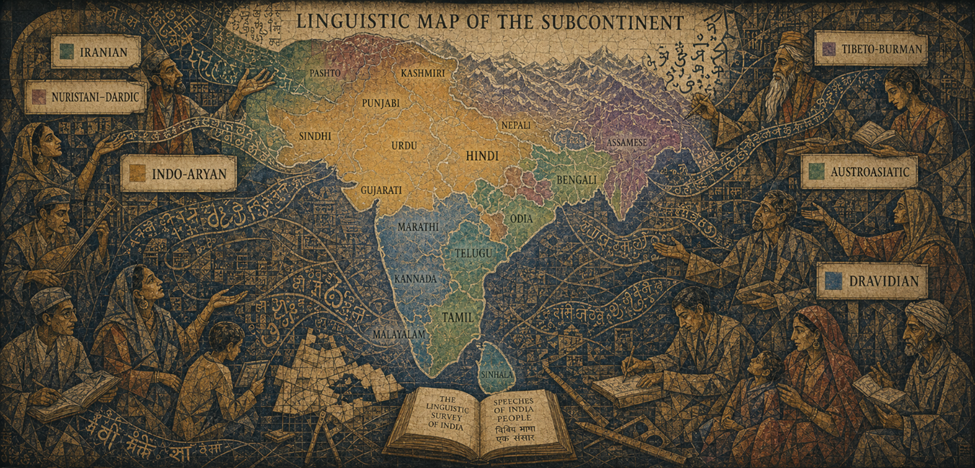
While Arabic and Persian served religious and administrative purposes, numerous local languages belonged to everyday life. People loved, argued, traded, and joked in their regional tongues. It was a composition of many tongues where no single entity tried to dominate the other but all of them formed a beautiful rhythm together.
Arabic possessed a religious authority. It was the language of the Qur’an and therefore central to theology, law, Hadith and the broader tradition of Islamic learning. Persian occupied an especially important position for centuries under several Muslim dynasties. It was used extensively in administration, court culture, literature, history and scholarship. These languages did not simply sit beside the local languages of the Subcontinent like foreign guests refusing to speak to anyone. They interacted and intermingled with them. Arabic and Persian words entered local vocabularies. Literary forms travelled between languages. Scholars moved across linguistic boundaries. As an inspiring outcome, Urdu itself emerged from precisely this kind of prolonged cultural contact. An educated Muslim could therefore inhabit several linguistic worlds. While his mother tongue would connect him to family and locality, Arabic would connect him to religious text and scholarship, Farsi would expand his literary horizon. Multilingualism was not considered an intellectual burden. It was simply part of being educated. Given that scenario, post-colonial modernity, strangely enough, has made us less ambitious and more dependent on a single language.
2. The Arrival of English in the Subcontinent
As colonial institutions expanded, English acquired growing importance in higher education, law, administration and government employment. The important change was therefore not that Indians began learning English and abandoned already established linguistic traditions. The difficulty began when one language became the gatekeeper through which nearly every serious opportunity must pass.
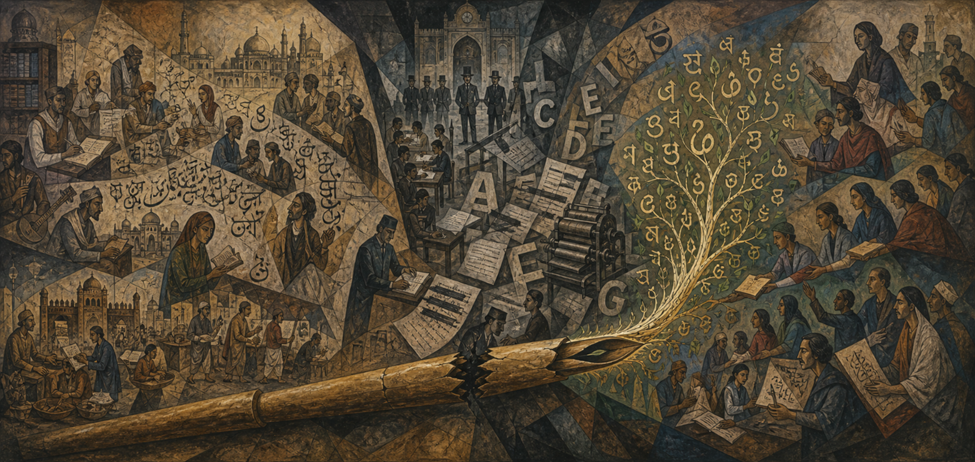
If a man knew English, institutions opened before him. If he knew Persian or Arabic, fewer did. The market, being a remarkably effective teacher, soon explained the new situation to everyone. Parents did not require philosophical arguments about linguistic policy. They could see which education produced employment, so a transformation that appears linguistic on the surface became psychological underneath.
When material advancement consistently rewards one kind of knowledge and neglects another, societies eventually begin to mistake economic usefulness for intellectual worth.
This is how linguistic imperialism often works. A language need not be prohibited in order to be defeated. It is enough to make another language the only source for societal success and prestige, and this is exactly what was done in the colonized Subcontinent.
3. Consequence for Muslims
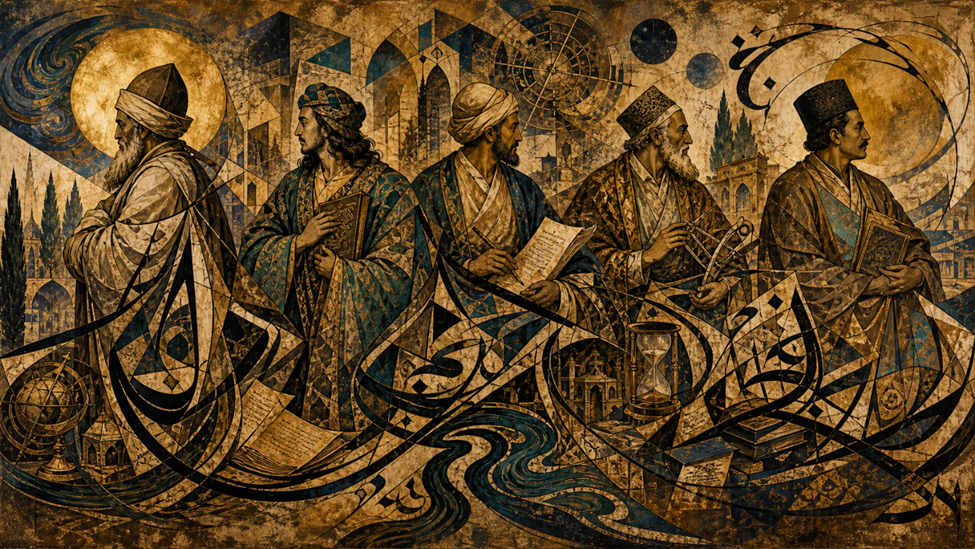
The decline of Persian and Arabic proficiency created a peculiar problem for the Muslims of South Asia. Arabic was the key to open the door to the understanding of Qur’an, Hadith, theology, jurisprudence, philosophy, history and an immense scholarly tradition extending across many centuries. Persian opened another door: to poetry, political thought, historiography, ethics and literature that had deeply influenced Muslim civilization in the Subcontinent. Sa’adi, Hafez and Rumi were not always remote names printed as an ornament. Persian literature once formed part of the intellectual environment of educated South Asian Muslims. So much so that the Persian works of Iqbal alone should make the modern South Asian reader hesitate before treating Persian as an irrelevant foreign language.
Yet today a curious situation exists. A person may passionately celebrate Rumi without being able to read and understand a single line from Mathna’vi or his Diwan. He may quote Hafiz or Khayam while remaining unable to approach a substantial portion of their poetry. He may recite the Qur’an beautifully while depending entirely upon translations to understand what he has recited. There is no disgrace in translation. But there is a difference between using translation as a bridge and living permanently on that bridge because one has forgotten how to reach the other side. In this regard, as direct linguistic access declined, ordinary Muslims became increasingly dependent upon specialists of respective languages for their own intellectual inheritance. Classical texts did not disappear, our ability to read them did. This distinction explains much of the present problem.
4. Colonizers Left but Linguistic Imperialism Did Not.
The British eventually left the Subcontinent, but their language behaved more prudently and stayed. This is not entirely unfortunate though. English is now one of the principal languages of international scholarship, science, technology, commerce and diplomacy. Anyone advocating that South Asians should abandon English in the name of cultural authenticity would merely replace one intellectual limitation with another. The sensible criticism of linguistic imperialism is therefore not an argument against English. It is an argument against its monopoly.
In Pakistan, India, Bangladesh and elsewhere in South Asia, English still carries an extraordinary amount of social prestige. An English-speaking child is readily described as intelligent even when he has said nothing intelligent. A person who speaks imperfect English may be judged less educated even when he knows his own language, history and profession far better. We have therefore performed a rather remarkable trick. We have confused command of a language with possession of intelligence. The two are obviously not identical. A fool who speaks excellent English still remains a fool.
The deeper problem appears when people begin feeling embarrassed by their own linguistic inheritance. English then ceases to be a useful instrument and becomes a measure of human worth. That is when linguistic imperialism achieves its lasting victory, not when people are forced to speak the imperial language, but when they voluntarily begin to think that everything important must somehow sound better in it.
5. The Wrong Solution: Declaring War on English
Cultural decline often produces two equally unhelpful reactions. The first is total surrender that dictates to abandon old languages because they are supposedly useless. The second is romanticism that condemns modern languages because they are supposedly corrupting. Neither deserves much enthusiasm.
In today’s world, English is the doorway to access enormous intellectual resources and opportunities to grow. Someone who refuses to learn it today may unnecessarily restrict his access to science, technology, research and international communication. On the same note, someone who learns English by sacrificing every deeper relationship with his own linguistic heritage has merely exchanged one form of ignorance for another.
The question should never have been:
English or Arabic?
Nor:
English or Persian?
Nor even:
English or mother tongue/Urdu?
A culture and linguistic tradition confident in itself does not need to choose, negate, or annihilate the other. It learns more about others. Therefore, the proper answer to linguistic imperialism is not linguistic isolation but additive multilingualism that dictates to acquire the languages needed for the present without surrendering those that provide access to the past.
6. The Revival
Here we encounter another difficulty. People frequently speak of “reviving Arabic” or “reviving Persian” with great enthusiasm and very little practical thought.
A language is not revived by praising it, nor is it revived by hanging aesthetic art of calligraphy on the walls.
If Arabic and Persian are to recover meaningful places in Muslim intellectual life, they must, once again, become languages that ordinary people can actually use in their daily life. This requires changing how they are taught.
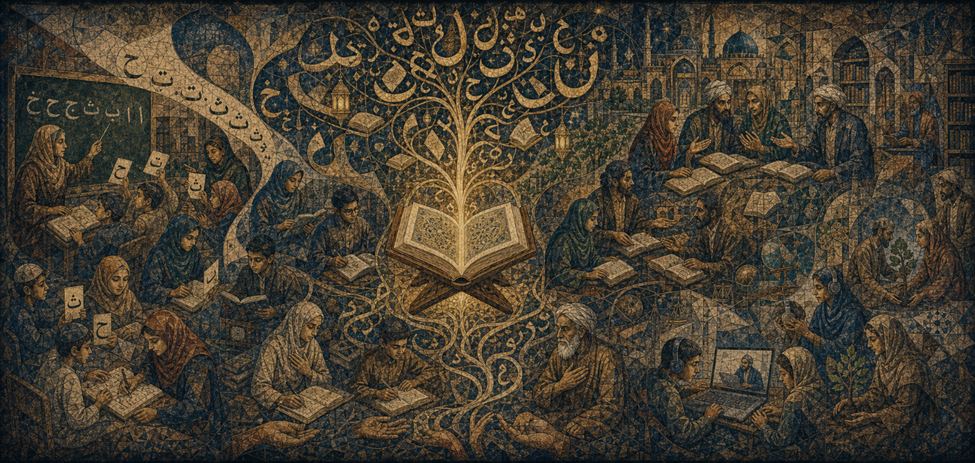
For many South Asian Muslims, Arabic education consists largely of learning how to pronounce the Qur’an correctly, memorizing grammatical terminology, or studying rules without reaching comfortable reading ability. These things may have value, but they should not be mistaken for fluency. Therefore, when it comes to practical language learning, the objective should be clear. After several years of study, a student ought to be able to open an accessible Arabic text and understand it with limited assistance. Teaching should therefore combine Qur’anic vocabulary, foundational grammar, reading comprehension and gradual exposure to classical Islamic prose. Students could begin with short Qur’anic passages whose vocabulary is explained carefully. They could then progress to selected Hadith, simple biographies, ethical literature and accessible classical texts.
Grammar should be there to serve reading rather than being an excuse for endless memorization. It is because a person does not learn to swim by spending ten years studying the chemical composition of water, but this is exactly what is done in case of Arabic teaching methodology in the subcontinent.
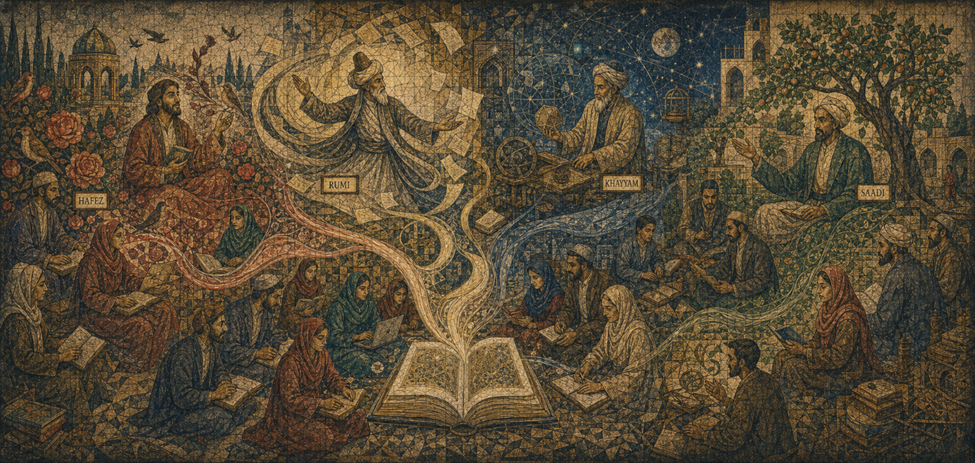
Persian presents a different opportunity. Its revival in South Asia need not begin with a nostalgia for old times. Its greatest attraction lies in the extraordinary literature that once shaped the region’s intellectual life. Students could begin with carefully selected passages from Sa’adi, Rumi, Hafiz and Iqbal, presented with translation, vocabulary and grammatical explanation. The aim should not initially be perfect conversational Persian. Reading proficiency alone would be a substantial achievement. Imagine a Pakistani university student being able to read parts of Iqbal’s Persian poetry without waiting for someone else to tell him what Iqbal meant. That is not antiquarianism. It is intellectual independence.
7. Technology Has Made Any Excuses Invalid
There is good news. Reviving linguistic knowledge today is far easier than it would have been even ten years ago. A learner no longer requires immediate access to a great traditional library or a private tutor. Digital dictionaries, recorded lectures, searchable texts, spaced-repetition vocabulary systems, audiobooks, online courses and bilingual editions have radically lowered the cost of language learning.
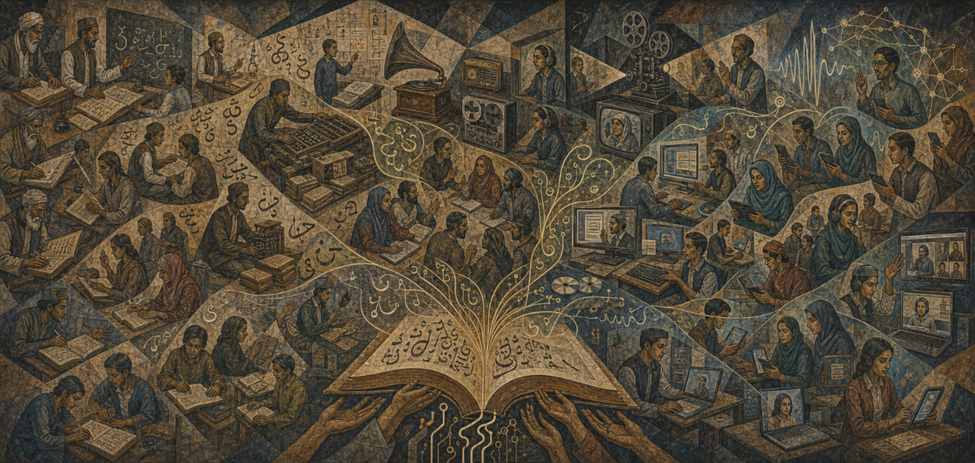
Imagine a serious multilingual curriculum built around four complementary functions:
English for global participation.
Urdu/Mother tongue for cultural and social rootedness.
Arabic for direct access to Islamic resources such as the Quran and other texts.
Persian for access to a major part of South Asian Muslim historical and literary civilization.
The purpose would not be to make every student a professional linguist. That is unnecessary. The goal should be functional literacy. One should be able to approach a text without helplessness. That modest goal, pursued systematically over ten or fifteen years of education, would produce extraordinary results.
8. Exactly What Are We Trying to Revive?
It is worth being precise here because cultural revival is easily confused with nostalgia.
The objective is not to recreate the past.
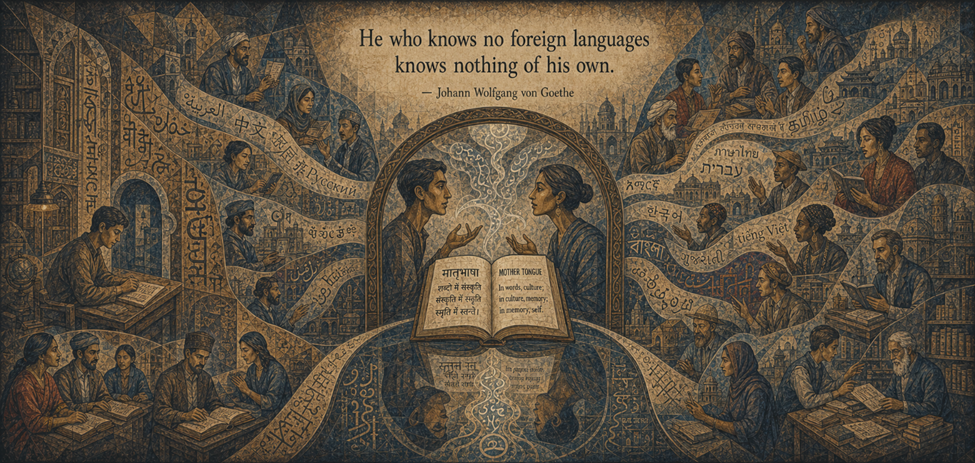
It is not to pretend that eighteenth-century institutions can simply be restored in the twenty-first century. It is certainly not to replace English domination with Arabic or Persian domination. The purpose is much simpler. It is to get direct access to the lost linguistic heritage. A Muslim who learns Arabic gains greater independence in approaching the foundational text of Islam. A South Asian who learns Persian gains access to centuries of poetry, history, philosophy and political thought that formed part of the intellectual environment from which modern South Asian Muslim culture emerged. A person who masters English gains access to the contemporary international world. A person who retains command of his mother tongue remains rooted in the people among whom he actually lives. Why should any of these achievements require the negation of the others? The assumption that we must choose one linguistic world is itself strangely impoverished as a wise man said, “He who knows no foreign languages knows nothing of his own”
Conclusion: A Multilingual Approach
The most dangerous consequence of linguistic imperialism is not that one language becomes powerful. Languages have always risen and declined with a change in their political status. The deeper danger occurs when a society loses the ability to approach its own intellectual inheritance except through foreign intermediaries.
A civilization that cannot connect with its own linguistic tradition eventually acquires a very peculiar relationship with its past. It praises authors it has not read, repeats ideas it has received second-hand, and converts intellectual traditions into mere slogans. Consequently, its heritage becomes ceremonial rather than a living one.
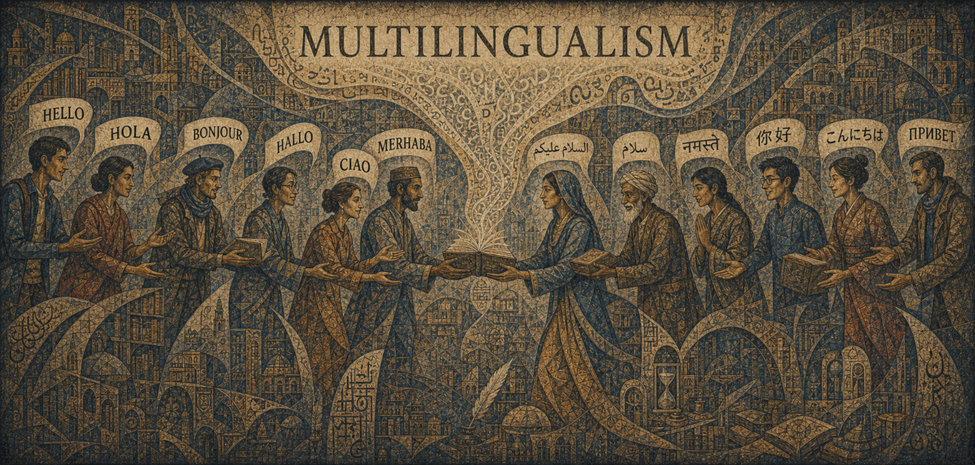
Keep in touch with your mother tongue. Learn English well and use Urdu proudly as a multicolored tapestry weaved from many linguistic traditions. Learn enough Arabic to approach the Quran and other religious sources of Islam. Recover enough Persian to discover the literary and intellectual horizon of Muslim South Asia. The goal is not to stick with a single language, for a truly multilingual person does not stand helplessly between competing worlds. He moves among them.
Therefore, the most effective response to linguistic imperialism is not to speak fewer languages, but to master enough of them that no single language can confine the mind. Multilingualism enables individuals, societies, and nations to broaden their perspectives, deepen their knowledge of the past, better understand the present, and shape a more promising future.