

Ask someone to name the capitals of Pakistan, and the answer seems obvious. Islamabad.
Ask where Pakistan’s first capital was, and most people will say Karachi.
That is where the story usually ends.
It shouldn’t.
Because for a brief and rather extraordinary period in Pakistan’s constitutional history, the country had a political geography that sounds almost impossible today. Karachi had been the original capital. Rawalpindi became the temporary seat of government. Islamabad was being built as the future capital. And, under the 1962 Constitution, Dhaka was formally recognised as the country’s second capital.
Four cities.
One country.
And a constitutional story that has almost disappeared from public memory.
Pakistan began its life in Karachi. The first Constituent Assembly met there on 10 August 1947, just days before independence. Jinnah became its president, the national flag was approved there, the Objectives Resolution was later passed there, and Pakistan’s first Constitution was adopted in the same city in 1956. Karachi was not merely the first capital on a map. It was where the new state was trying to figure out what kind of state it was going to be.
Then the capital moved.
But not directly to Islamabad.
That is the part many accounts skip.
In 1959, under Ayub Khan, the federal government was shifted from Karachi to Rawalpindi while plans for a new capital were being developed. Rawalpindi was therefore an interim seat of government, not the grand planned capital Pakistan eventually imagined for itself. The legal arrangements were quite explicit: Islamabad was designated as the future capital, but until the new capital could actually accommodate the government, Rawalpindi would serve as its principal seat.
And Islamabad was not built merely because someone wanted a prettier capital.
There were practical and political calculations behind it.
Karachi was Pakistan’s largest commercial centre and its most important port. It was also on the country’s southern edge. The new capital was supposed to be more centrally placed, easier to connect with the rest of the country, and physically separated from the pressures of a commercial metropolis. Security considerations mattered too. The location near Rawalpindi placed the future capital close to the military headquarters and the northern part of the country.
But then comes the part that makes the story genuinely fascinating. Dhaka.
Today, it is difficult to imagine Dhaka being described as a capital of Pakistan. But constitutional history does not care what later generations find intuitive.
The 1962 Constitution did something unusual. It provided for a “second Capital” and designated Dhaka as the Dacca Capital Territory. At the same time, Islamabad was to be the principal seat of the Central Government, while Rawalpindi would continue to serve that function until the government could be established in Islamabad. The principal seat of the National Assembly was to be at Dhaka.
Read that again.
Islamabad was the seat of the Central Government.
Dhaka was the principal seat of the National Assembly.
Rawalpindi was the temporary seat of government.
And Karachi had been the country’s original capital and the place where the first constitutional foundations had been laid.
This was not a neat story of one capital replacing another.
It was a reflection of a much deeper problem.
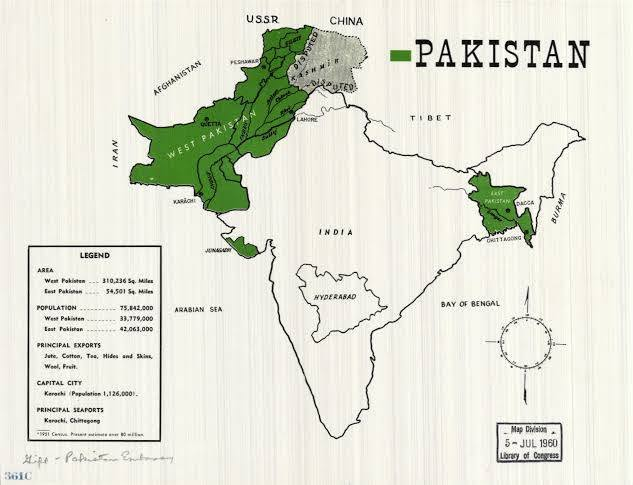
Pakistan had two wings separated by more than a thousand miles of Indian territory. East Pakistan contained a demographic majority of the country’s population, while political and administrative power was increasingly concentrated in the western wing. The constitutional arrangement around Dhaka and Islamabad therefore carried a significance that went far beyond geography.
It was an attempt, at least on paper, to accommodate a country that was geographically divided and politically unequal.
Whether it succeeded is another question.
It didn’t.
And this is where the story stops being an interesting constitutional footnote and becomes something much more serious.
A capital is never just a city.
It tells you where power lives.
When Islamabad was being designed, Pakistan was also being redesigned politically. The 1958 coup had already ended the country’s first constitutional experiment. The 1962 Constitution replaced the parliamentary system with a presidential one. Provincial autonomy was curtailed, and political authority became increasingly centralised.
So while architects were drawing the geometry of Islamabad, politicians were drawing something else: the geography of power.
And perhaps that is why the story of Pakistan’s capitals deserves more attention than it receives.
We tend to teach constitutional history as a list of dates.
1947. Independence.
1948. First Constitution.
1949. Martial Law.
1950. Second Constitution.
1951. Constitution abrogated.
1952. Present Constitution.
The dates are correct.
The story is missing.
Because behind those dates were real arguments about representation, authority, federalism and the question of who Pakistan was actually being built for.
Even the physical movement of the government tells us something.
Karachi represented the Pakistan that had just emerged from Partition.
Rawalpindi represented an interim state increasingly shaped by a powerful military establishment.
Islamabad represented the ambition to build a new administrative centre from scratch.
And Dhaka represented the other half of Pakistan, a half that was constitutionally acknowledged but increasingly dissatisfied with the distribution of political power.
Then history delivered its verdict.
In 1971, East Pakistan became Bangladesh.
The constitutional experiment of two capitals disappeared with the country it had been designed to accommodate.
Islamabad remained.
Dhaka became the capital of Bangladesh.
And the strange four-city chapter of Pakistan’s constitutional history faded into something most people never learn.
Perhaps that is the real lesson.
The history of a country is not always written in the monuments we still have.
Sometimes it is hidden in arrangements that no longer exist.
In an old constitutional clause.
In a city that was once a capital.
In a government that temporarily sat somewhere else.
In a second capital that belonged to a country that no longer exists.
Pakistan today looks geographically and politically straightforward on a map.
Its constitutional history is anything but.
And if we want to understand why the country developed the way it did, perhaps we should stop asking only, “What was the capital?”
The more revealing question is:
Where was power supposed to be, and who was supposed to have it?
That question takes us far beyond Islamabad.
It takes us back to Karachi.
Through Rawalpindi.
Across to Dhaka.
And eventually, to the constitutional choices that helped shape Pakistan itself.