


Is navigating the future the most important skill of the 21st century? As the famous adage goes, “The best way to predict the future is to create it.” Indeed, the rise and fall of nations, the sudden emergence of the internet, and the global domination of artificial intelligence have all validated the utter uncertainty of what lies ahead. The future is neither definite nor linear. Instead, it is a constantly moving landscape prompted by one’s imagination, action, and the dare to challenge deeply held assumptions. This aligns with the pioneering futurist Jim Dator’s observation that “any useful statement about the future should at first seem ridiculous.”
Yet, is the echo of past trends drowning out the fragile signals of tomorrow? Often, the sheer weight of yesterday corrodes our capacity to imagine a new dawn. Every civilization is bound by a cluster of inherited customs, rigid institutions, and unexamined norms that dictate human behavior. While these legacy systems offer temporary stability, they easily morph into irreversible prisons that blind us to emerging possibilities. When we equate “tradition” with “irreversibility,” we paralyze innovation. Foresight demands that we treat the past as a stepping stone rather than a mental cage, remembering that the future belongs to those rewriting history, not those clinging to it. This is the very essence of strategic foresight. Unlike traditional forecasting, which relies on linear predictions, foresight explores multiple possible futures, actively challenges existing assumptions, and designs a preferred future rather than simply reacting to events.
To achieve this, we must shift our mindset from the passive prediction of “what will happen” to the active creation of “what do we want?” The legendary sociologist and futurist Fred Polak beautifully illustrated this dynamic in his seminal work, The Image of the Future. He argued that societies are fundamentally sculpted by their collective imagination; where optimistic visions catalyze innovation, investment, and systemic progress, a deficit of hope triggers societal stagnation. This dynamic is historically undeniable. Nations have survived catastrophes, and visionary companies like Apple or SpaceX have evolved, simply by looking beyond the immediate horizon. Thus, a bold, shared vision becomes the actual blueprint for a transformative future.
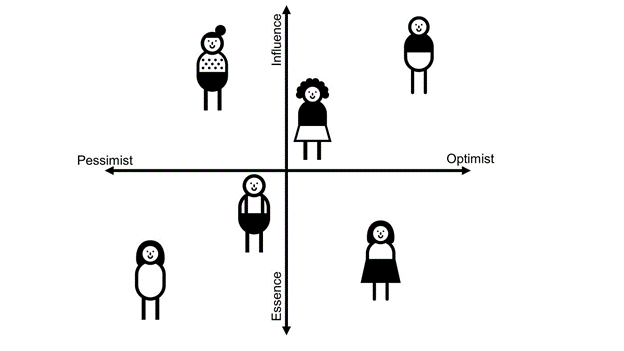
Yet, our greatest obstacle to achieving this radical breakthrough might be ourselves. We routinely view the future through what futurists describe as “the peep-hole of the future”, a narrow lens obscured by our personal assumptions, experiences, and cognitive biases. These forces quietly shape our decisions until we mistake our limited perspectives for objective facts.
The COVID-19 pandemic shattered these deepest illusions. For decades, we believed that physical classrooms, rigid work schedules, and face-to-face services were unalterable truths of modern life. Yet, a sudden global lockdown revolutionized each one of them, shifting us overnight to virtual learning, remote operations, and work-from-home realities. This disruption is precisely why strategic foresight demands the constant, rigorous cross-examination of our most set-in-stone assumptions.
History consistently supports the claim that the future begins with the seemingly absurd. Moving across the deep seas, and later flying over them, was once dismissed as a madman’s dream; today, it is our quiet reality.
To systematically turn these “dreams into reality,” futurists rely on a practice called Horizon Scanning. This is the art of sailing the ship across seemingly impossible terrain with proper planning, specifically by identifying hidden strengths, weaknesses, and potential disruptions before they ever become mainstream. By looking past short-term, flashy trends, we can focus on long-term Mega Trends, allowing societies and organizations to lead the narrative instead of scrambling in the dark. A critical factor in this practice is successfully separating the two. While regular trends are hype-driven, temporary entities that quickly recede, Mega Trends are massive forces that reshape global lifestyles over decades. This distinction forces us to ask: is Artificial Intelligence merely a passing trend, or is it a true mega trend?
To make sense of these overwhelming forces, futurists frequently use a tool called the Futures Triangle. This framework maps out the intangible, competing forces that collectively shape our destiny:
- The Pull of the Future: Our highly inspiring, preferred destination.
- The Push of the Present: The undeniable drivers and immediate truths of today.
- The Weight of History: The haunting past and inherited barriers we carry.
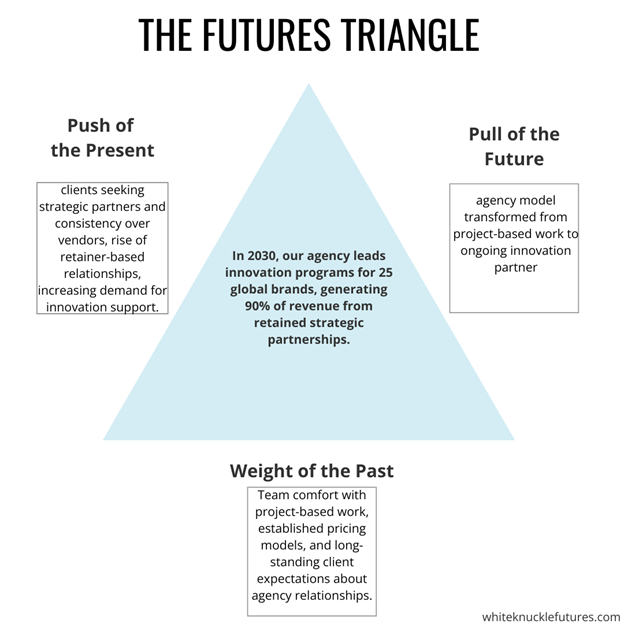
Understanding the tension between these three points allows us to look beyond a bleak, reactionary outlook and peer into infinite possibilities. By strategizing instead of crashing, we learn to look in the right places. We can clearly identify what is pulling us forward, what aspects of the present should be embraced, and what historical baggage must be overcome. Only then can we design strategies that actively move us toward our preferred future.
An old Greek proverb suggests, “A society grows great when old men plant trees whose shade they know they shall never sit in.” The future is not a singular, predetermined destination waiting to unfold, but a complex canvas to be planned, anticipated, and carefully designed. Every decision we make today directly shapes the world our descendants will inherit. As the ancestors of tomorrow, it is our duty to master the art of thinking beyond the immediate horizon, anchoring our legacy not as passive victims of the past, but as the active architects of a wiser tomorrow.