


“O Prophet, indeed We have sent you as a witness and a bringer of good tidings and a warner. And one who invites to Allah, by His permission, and as a light-giving lamp.”
Surah Al -Ahzab (33: 45-46)
Abstract
This article aims to shed a light on the journey of the Prophet of Allah ﷺ from Makkah (his birth place) to Medina. How this strategic move changed the trajectory of Islam, and how we can learn from his life and apply his teachings in our lives.
Martin Lings, “Muhammad: his life based on the earliest sources” will be used as a primary source.
Introduction
Before receiving the revelation from God, solitude became dear to him and he ﷺ would go for spiritual retreats to a cave in Mount Hira. This was not a strange thing for the Quraysh as it was practiced for a long time amongst the descendants of Ishmael. It was one night towards the end of Ramadan, in his fortieth year, there came to him an Angel and said to him : “Recite!”. This was the moment that changed everything. The Prophet ﷺ descended the slope and went to his house. “Cover me! Cover me!” he said to Khadija (RA). She quickly brought the cloak and spread it over him. After sometime the Prophet ﷺ shared the entire thing and this way Khadija (RA) became the first person to enter the fold of Islam.
The story doesn’t end here. It actually begins from here.
No summons to Islam were made in public, yet. But there was an ever-increasing group of devout believers, both men and women, most of them young. After the revelation of the verse “Warn thy family who are thy nearest of kin” Surah AshShu’ara (26:214), the Prophet ﷺ came out with his message publicly starting from his immediate family but not one of the Prophet’s four uncles showed any inclination to follow him. The next target were the Quraysh who vehemently opposed him and eventually the Prophet ﷺ had to leave Makkah and migrate to Medina (which will become his strong base for the propagation and expansion of Islam).
Quraysh in Action
The public preaching of the Prophet ﷺ towards Islam and One God deeply frustrated the Quraysh and their leaders. They came to Abu Talib ( the uncle of the Prophet) and said :
“ O Abu Talib, you are an honourable man amongst us, and we are asking you to hold in check your brother’s son. By God, we will not suffer our fathers to be insulted and our Gods reviled, either stop him, or we will fight you both”.
The Quraysh had no problem with the Prophet ﷺ as he was an extremely respectable guy. The problem was his message and his new “movement”. It was challenging their power, their belief, and their forefathers. This was not acceptable to the Quraysh. They were not able to attack him directly so they confined themselves for the moment to organising a widespread execution and killing of all the adherents of the “new religion” who had no one to protect them. In this way, the sacrifice began before the message was finished and it continues still.
In the meantime, they consulted together in an attempt to defame and slander the Prophet ﷺ so that the people of Makkah can be stopped from converting. Walid the son of Mughirah, the most influential man of the tribe at that time, advised them to let their unanimous accusation be that Muhammad ﷺ was a dangerous sorcerer who is dividing people and should be avoided at all costs. They used this tactic because they knew how winning he could be. Had he not been one of the most loved men in Makkah? Nor had his tongue lost any of its eloquence. ﷺ
Quraysh make offers and demands
So far, the Quraysh had failed in their every attempt to stop the movement and message of Islam. This time they thought of offering something to the Prophet ﷺ so that he may be stopped. Utbah ibn Rabi’ah was chosen for this task. He was
intelligent, less violent, and had a common ancestor as he was the grandson of Abdu Shams, the brother of Hashim. He said to the Prophet ﷺ :
“ if you seek wealth, we will put together a fortune for you. If you seek honour, we will make you our overlord, and if you want kingship, we will make you, our king; and if you have a spiritual disease, we will find you a physician and spend our wealth until your cure be complete”.
The Prophet of Allah ﷺ however, started reciting an ayah from the Quran:
“ And of His signs are the night and day and the sun and moon. Do not prostrate to the sun or to the moon, but prostrate to Allah, who created them, if it should be Him that you worship”.
~ Surah Fussilat (41:37)
While the Quraysh were plotting in their councils, another battle was being won in the shadows i.e. hearts were turning. Hamza, the lion of Allah, stood with his nephew. Umar, the one who once burned to extinguish this faith, became its fiercest shield. And with every soul that entered Islam, the movement grew not just in number, but in unbreakable force.
It is important to remember: Islam was just beginning at this stage. The Prophet ﷺ remained incredibly patient and never responded to the insults or slanders of his enemies. Instead, he was busy working on people’s hearts, drawing them in and building their character. That’s what created a movement that would change the world.
However, the situation became difficult for Muslims to a level where they were forced to leave Makkah and migrate to Medina – their new home.
The Entry into Medina
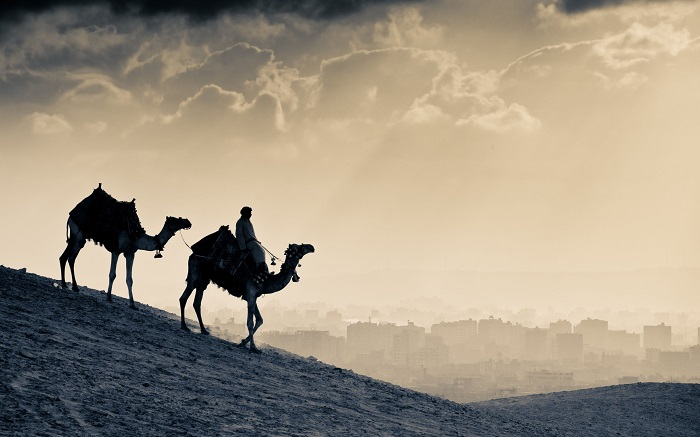
The Prophet’s ﷺ arrival in Medina on 27 September 622 CE was the strategic pivot that transformed a persecuted faith into a fledgling state. After a triumphal procession through jubilant crowds chanting “Come is the Prophet of God,” his camel Qaswa knelt at a courtyard owned by two orphans, which he purchased and immediately ordered to be built as the first mosque. The Muslims of Medina were titled Ansar (Helpers), while the Meccan emigrants were called Muhajirun and the Prophet ﷺ personally labored alongside them, chanting verses as they built.
Further, a covenant was established with the Jewish tribes of Yathrib, forming a single community (ummah) where Muslims and Jews had equal status, mutual protection, and indivisible peace, though the Jews accepted largely for political reasons, resentful that the promised Prophet was not from their own.
But victory was not without internal fracture. The hypocrite ‘Abd Allah ibn Ubayy, once poised to be king of Medina, watched his influence evaporate and seethed with bitterness.
“And when they meet those who believe, they say, ‘We believe’; but when they are alone with their evil ones, they say, ‘Indeed, we are with you; we were only mockers.”
~ Surah Al Baqarah (2:14)
Old tribal feuds reignited when a Jewish politician exploited poetry of Aws and Khazraj of their past wars, nearly drawing swords again until the Prophet ﷺ rushed to pacify them.
Medina soon became the unshakable base from which the Muslim message radiated outward. Tribes sent delegations, alliances were forged, and within two years, the movement was strong enough to confront Quraysh militarily. At Badr — the first decisive battle — a small, ill-equipped Muslim force defeated a vastly superior Meccan army, proving that divine support and strategic unity could overcome material might. The movement had entered a new phase: from survival, to governance, to expansion.
Conclusion
The Hijrah was never just a migration. It was a masterclass in strategic leadership. The Prophet ﷺ did not flee out of weakness; he pivoted toward opportunity, turning a barren oasis into the capital of a civilization. He proved that movements are not built by force alone, but by vision, patience, and the ability to read the moment. The Quraysh had power, wealth, and numbers, but the Prophet ﷺ had something greater: clarity of purpose and the trust of his people. He built institutions — a mosque, a constitution, a community — before he built an army. He managed internal dissent with wisdom, and external threats with courage. And when the time came, he struck decisively(Badr) , the movement announced its arrival to the world. The lesson is timeless: a movement that anchors itself in principle, adapts to circumstance, and never loses sight of its mission will outlast every empire that stands against it.
References/ further reading:
Lings,Martin. Muhammad: his life based on the earliest sources
Ahmed,Israr. Manhaj e Inqilab e Nabwi ﷺ