

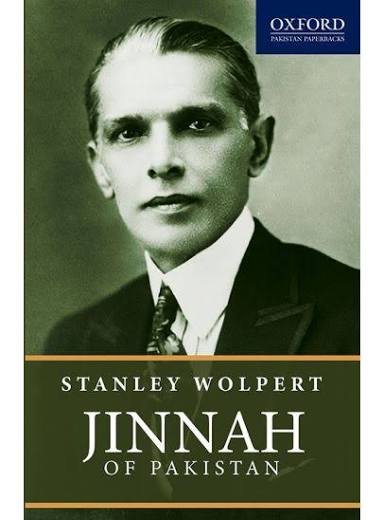


Book review by Tahreem Amanullah Bukhari
What kind of man does it take to create a country?
That is the question that kept returning to me while reading Stanley Wolpert’s Jinnah of Pakistan. Not because Wolpert gives us a simple answer, but because he makes the question increasingly difficult to answer. By the end of the book, Muhammad Ali Jinnah is no longer just the Quaid-i-Azam of national memory. He becomes a far more complicated man: fiercely determined, politically calculating, intensely private, occasionally stubborn, and remarkably capable of holding his ground when almost everyone around him seemed to be moving in another direction.
That is what makes this biography worth reading.
Wolpert does not begin with the Jinnah we already know. He takes us back to the young lawyer in Bombay, ambitious and impeccably dressed, who initially believed that Hindu-Muslim political cooperation was possible. This is perhaps one of the most interesting parts of Jinnah’s story. The man who would eventually become the strongest advocate for a separate Muslim state did not begin his political career with Partition as his destination.
His journey was much less straightforward.
Wolpert carefully follows the political disappointments, disagreements and changing circumstances that gradually transformed Jinnah’s politics. His relationship with the Congress deteriorated. His confidence in constitutional safeguards weakened. The Muslim League became increasingly important. And, slowly, the demand for Muslim political security developed into something much larger.
What I particularly appreciated was that Wolpert does not make Partition look inevitable.
We know how the story ends. That is precisely the problem when reading history. Once we know the outcome, everything before it can look as though it was leading there. Wolpert largely avoids that trap. His account reminds us that Pakistan was not simply waiting to happen. There were other possibilities. There were negotiations, compromises, failures and missed opportunities. There were personalities involved, and personalities matter in history.
Jinnah matters enormously.
But he is not alone.
This is where the book becomes more than a biography. Wolpert places Jinnah within the wider political struggle involving the Congress, the Muslim League and the British. Gandhi, Nehru, Liaquat Ali Khan and other political figures appear not merely as names surrounding Jinnah, but as people whose decisions affected the direction of events. The result is a much more complicated picture of the final years of British India.
And then there is Jinnah himself.
He is perhaps most impressive when Wolpert describes his political discipline. Jinnah was not a charismatic mass leader in the mould of Gandhi. He did not rely on emotional speeches or a carefully cultivated image of personal simplicity. His power came from something different: precision, persistence and an extraordinary confidence in his own political position.
He could wait.
He could negotiate.
And, perhaps most importantly, he could refuse to give way.
That strength was also one of his weaknesses. The same determination that made Jinnah an exceptionally effective political leader could make him inflexible. Wolpert does not hide this contradiction. His Jinnah is admirable in some moments and frustrating in others. That makes him more believable.
It also makes the book more uncomfortable.
A national founder is rarely remembered as an ordinary human being. With time, people become symbols. Their contradictions are softened. Their difficult decisions are explained away. Their private lives disappear behind portraits, speeches and monuments.
Wolpert tries to pull Jinnah back from the monument.
He does not destroy the image of the Quaid. He complicates it.
That, in my view, is the greatest strength of Jinnah of Pakistan.
The book is not without its limitations. At times, the political detail becomes heavy, particularly for a reader who is not already familiar with the personalities and rivalries of late colonial India. Wolpert is much more interested in Jinnah the politician than Jinnah the private man, so readers looking for an intimate portrait of his personal life may find parts of the biography somewhat distant.
Yet perhaps that distance is appropriate. Jinnah himself was a remarkably private person. There is something almost fitting about a biography in which the political man is easier to reach than the personal one.
I finished Jinnah of Pakistan with more questions about Jinnah than I had before I started it.
For me, that is a sign of a good historical biography.
A weak biography gives you a conclusion. A good one gives you a better understanding of why the conclusion was never as simple as it seemed.
Wolpert’s Jinnah is neither the perfect hero of unquestioning national mythology nor the cold political strategist that some interpretations reduce him to. He is a man shaped by his time, but also a man who shaped his time. He made choices. He miscalculated at times. He succeeded spectacularly at others. And, ultimately, he helped bring into existence a country whose future he himself would have very little time to shape.
Pakistan was born in 1947.
Jinnah died only a year later.
That final irony gives the whole story a certain sadness. The man who had spent decades fighting for a political future for India’s Muslims was given barely thirteen months to inhabit the country he had helped create.
Perhaps that is why Jinnah of Pakistan stays with the reader. It is not merely the story of how a country came into being. It is the story of a man who spent most of his life fighting for a political idea, only to find himself with very little time to live in its reality.
And that makes Jinnah’s story much more human than the portrait on the currency notes ever allows us to see.

Tahreem Amanullah Bukhari
The author holds a Masters degree in English Linguistics. Her areas of interest/research are history, Islam, languages, fiction and poetry. She works as a translator, novel writer, poet and educator, exploring stories across cultures and languages.