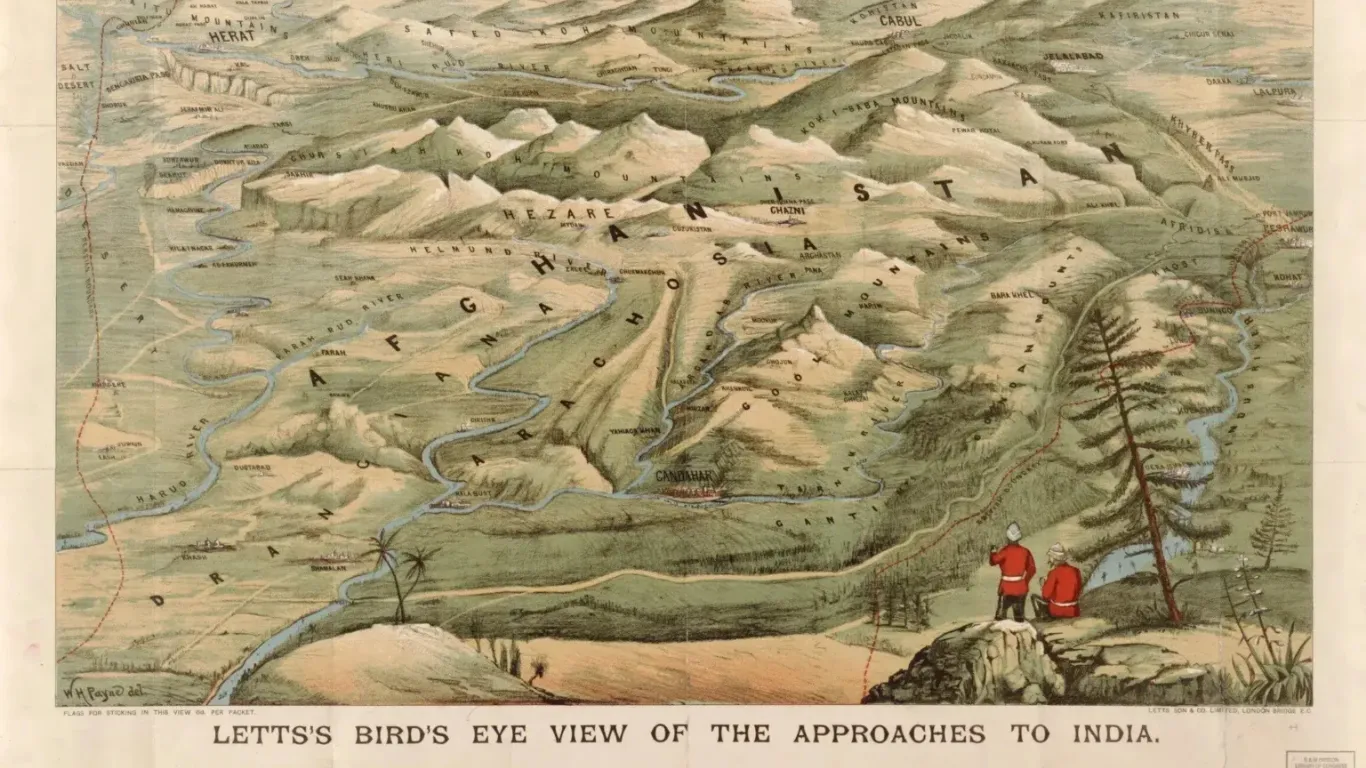


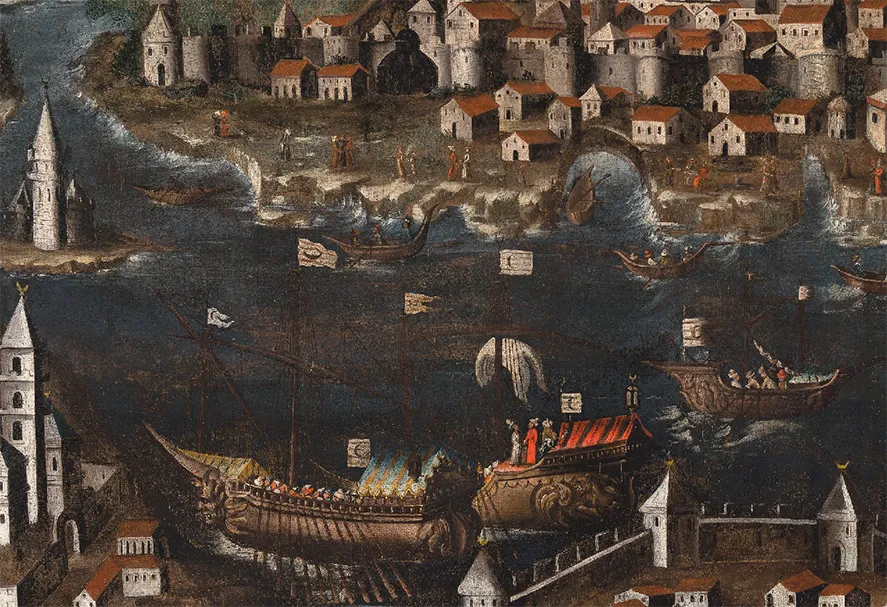
(A 16th century oil painting commissioned to commemorate a celebrated ancestor, Luchino Dal Verme (c1320–67), https://www.cornucopia.net/blog/constantinopoli-circa-1600)
“If the entire world were a single state, Istanbul would be its capital.”
The quote is famously attributed to Napoleon Bonaparte, a reflection of the city’s unmatched strategic and civilizational significance.
On 29 May 1453, a city long regarded as unconquerable finally fell. Constantinople, known throughout history as Byzantium, the Queen of Cities, Istinpolin, Stamboul, and eventually Istanbul, was conquered by the armies of the Ottoman Sultan Mehmed II. At only twenty-one years of age, the seventh Ottoman ruler accomplished what generations of emperors, caliphs, and commanders had sought before him. History would remember him as Mehmed the Conqueror, the Fatih of Kustuntuniyya.
Yet the story of the conquest begins long before the Ottomans appeared outside its walls.
From Byzantium to Constantinople
The city traces its origins to 657 BC, when a Greek ruler named Byzas founded a settlement on the European side of the Bosporus Strait. Known as Byzantium, the settlement flourished because of its location. Positioned at the crossroads of Europe and Asia, it controlled access between the Black Sea and the Mediterranean.
In AD 330, Roman Emperor Constantine transformed the city into his “New Rome,” establishing it as the capital of the Eastern Roman Empire. As Christianity became the empire’s defining faith, Constantinople emerged as one of the most influential cities in the world. Its wealth, learning, trade, and political importance earned it the title of the “Queen of Cities.”
Researchers have noted that ancient Byzantium had never become a truly major city before Constantine. Its natural role was to serve as a gateway to the Black Sea. Constantine’s decision elevated it into something far greater, a capital that would shape the destiny of empires for over a millennium.
Its geographical position remains just as important today. Istanbul, today physically straddles the Bosporus, the narrow waterway connecting the Black Sea to the Sea of Marmara and ultimately the Mediterranean. For Black Sea nations, it remains the only maritime gateway to the world’s oceans.
The Walls of an Empire
Despite its strategic advantages, Byzantium possessed a serious weakness. Unlike many ancient capitals, it lacked strong natural barriers against attacks from the hinterland. To compensate, massive defensive walls were constructed.
Completed under Emperor Theodosius II in AD 413, the famous Theodosian Walls transformed Constantinople into one of the most heavily fortified cities in history. Consisting of multiple defensive layers, towers, and moats, they protected the city for centuries.
(The walls have been designated as a UNESCO world heritage site since 1985.)
The walls soon became legendary.
As the capital of the Byzantine Empire, Constantinople survived siege after siege. Arab armies in the seventh and eighth centuries failed to breach its defenses. Bulgarians and Rus armies met similar fates in later centuries. The city became synonymous with endurance.
But during the Fourth Crusade in 1204, crusaders diverted from their original mission and brutally sacked the city, establishing a Latin state.
Although Byzantine rulers recaptured Constantinople in 1261, the empire never fully recovered. By the fifteenth century, the city remained the principal population center of an empire that had largely faded into a shadow of its former self.
Islam, Anatolia, and the Road to Constantinople
Muslim contact with Anatolia began in the seventh and eighth centuries when Arab armies from the Umayyad and Abbasid Caliphates reached Byzantine frontier regions. Through trade, military encounters, and cultural exchanges, Islam gradually spread among the Turkic peoples of Central Asia.
A decisive turning point came in 1071 at the Battle of Manzikert. There, the Seljuk Sultan Alp Arslan defeated the Byzantine army in one of the most consequential battles of medieval history. The victory opened much of Anatolia to Turkic settlement and accelerated the region’s transformation.
Yet Constantinople itself remained beyond reach.
For centuries, Muslim rulers and armies sought its conquest. The city continued to stand behind its walls, seemingly invincible. By the middle of the fifteenth century, however, a young Ottoman ruler was determined to change that reality.
The Sultan and the Prophecy
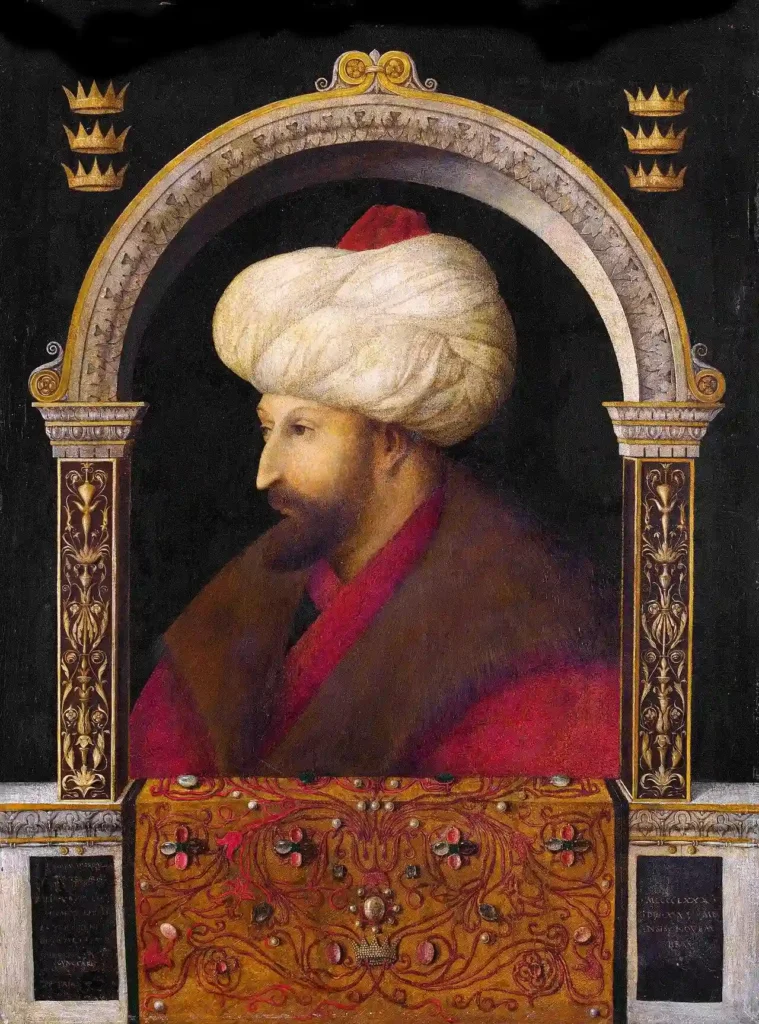
(Portrait of Mehmet II by Gentile Bellini, dating 1480)
When Mehmed II ascended the Ottoman throne for the second time, he directed his attention toward Constantinople. Unlike many of his predecessors, he was unwilling to preserve the status quo.
For Mehmed, Constantinople represented more than a strategic objective. It was a powerful Christian enclave surrounded by expanding Muslim territories, a political and military center that had repeatedly supported coalitions against Muslim powers. The memory of Byzantine involvement with crusading efforts, including campaigns such as Nicopolis, remained fresh. When Byzantines abetted Crusader against his grandfather.
The city also carried immense symbolic significance.
A famous narration attributed to Prophet Muhammad (SAW) states:
“You will conquer Constantinople. The best commander is its commander and the best army is its army.”
(Scholars have differed regarding the authenticity of the specific wording praising the commander and army. However, the prophecy concerning the conquest of Constantinople itself appears in authentic Islamic sources, including Sahih Muslim.)
For generations, Muslim rulers viewed the city’s conquest as a noble aspiration. Mehmed intended to be the one who fulfilled it.
Preparing for the Impossible
At twenty-one years old, Mehmed launched one of the most ambitious military projects of the medieval era.
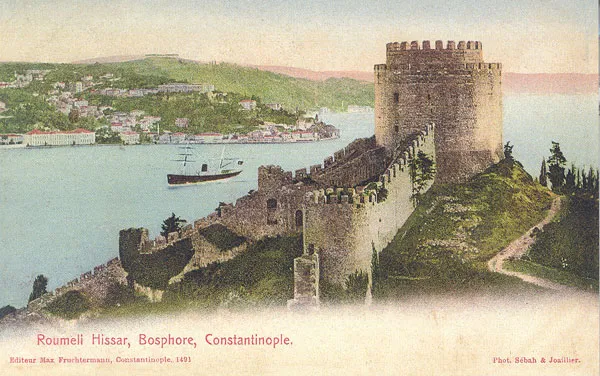
To isolate Constantinople, he ordered the construction of Rumelian Castle on the European shore of the Bosporus. Completed in only four months, the fortress enabled Ottoman artillery to dominate maritime traffic entering the city.
Mehmed personally involved himself in planning every aspect of the campaign. He studied maps, examined the walls, designed siege works, and encouraged innovations in military technology. It is written that Mehmed spent his nights sketching the city walls by candlelight, mapping out trenches, and designing movable wooden siege towers. His crown jewel was a revolutionary, 600 kg super-cannon utilizing a brand-new combined firing technique, a massive bombard capable of firing enormous stone projectiles against fortifications previously considered indestructible.
In March 1453, he marched toward Constantinople with an army estimated at around 100,000 men.
Inside the city, Byzantine defenders prepared for a desperate struggle. Their greatest confidence rested in the famous triple-layered walls and the enormous iron chain stretched across the entrance of the Golden Horn, preventing hostile ships from entering the harbor.
According to the Islamic rulings, Sultan offered the Byzantines for surrender first but when the defenders rejected Mehmed’s offer of surrender, the siege began.
The Siege of Constantinople
The Ottoman bombardment shook the city day after day. Yet the walls continued to resist.
Then Mehmed unveiled one of history’s most famous military maneuvers.
Unable to force his fleet past the chain guarding the Golden Horn, he ordered ships to be dragged overland. Ottoman engineers laid greased wooden tracks across the hills overlooking the harbor. Under the cover of darkness, warships were hauled across land and launched behind the Byzantine defenses.
The sight stunned the defenders.
What had seemed impossible had become reality overnight.
As the siege continued, shortages inside the city worsened. Constant artillery fire weakened the defenses, while repeated Ottoman assaults exhausted the defenders. The psychological pressure mounted with each passing day.
By late May, the situation had become critical.
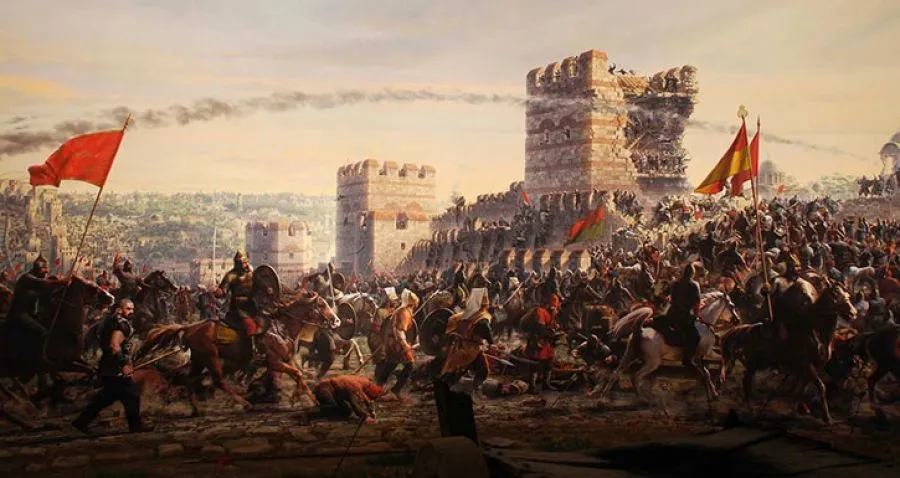
(Panorama 1453 History Museum in Istanbul)
29 May 1453, The Day of Conquest
Before dawn on 29 May, Mehmed launched the final assault.
Wave after wave of Ottoman troops advanced toward the breached sections of the walls. Irregular forces attacked first, followed by Anatolian infantry. Behind them came the elite Janissaries.
The attacks were continuous, coordinated, and supported by relentless artillery fire.
Contemporary historian Kritovoulos records that Mehmed himself advanced toward the breach, directing and encouraging his soldiers during the decisive moments of the battle.
Eventually, the exhausted Byzantine defenses collapsed.
Emperor Constantine XI is believed to have died fighting near the walls, becoming the last Roman emperor. After more than eleven centuries, the Byzantine Empire ceased to exist.
Constantinople had fallen.
A New Chapter Begins
The conquest of Constantinople marked far more than the capture of a city.
It ended the Byzantine Empire, strengthened Ottoman power, reshaped trade routes, and transformed the balance of power between Europe and Asia. Many historians regard it as one of the events that closed the medieval era and opened the path toward the early modern world.
The city itself did not decline. Instead, it entered a new phase of life under Ottoman rule. Constantinople, and later Istanbul, became the capital of an empire that would span three continents and endure for centuries.
The walls that had resisted countless armies finally yielded on 29 May 1453. Yet the city’s importance remained unchanged.
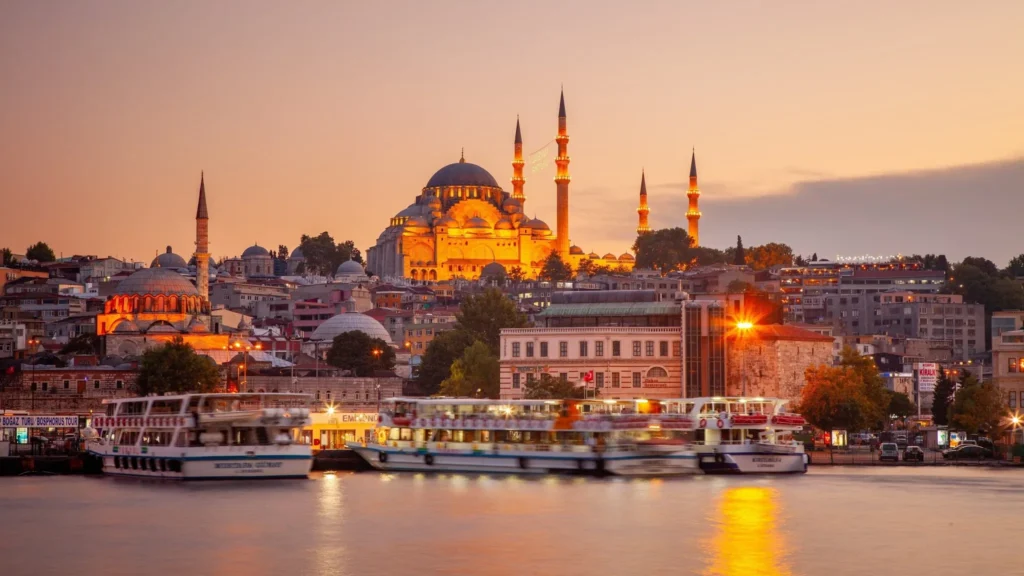
As it had for centuries, and as it still does today, Istanbul continued to stand at the meeting point of continents, civilizations, faiths, and history itself.