
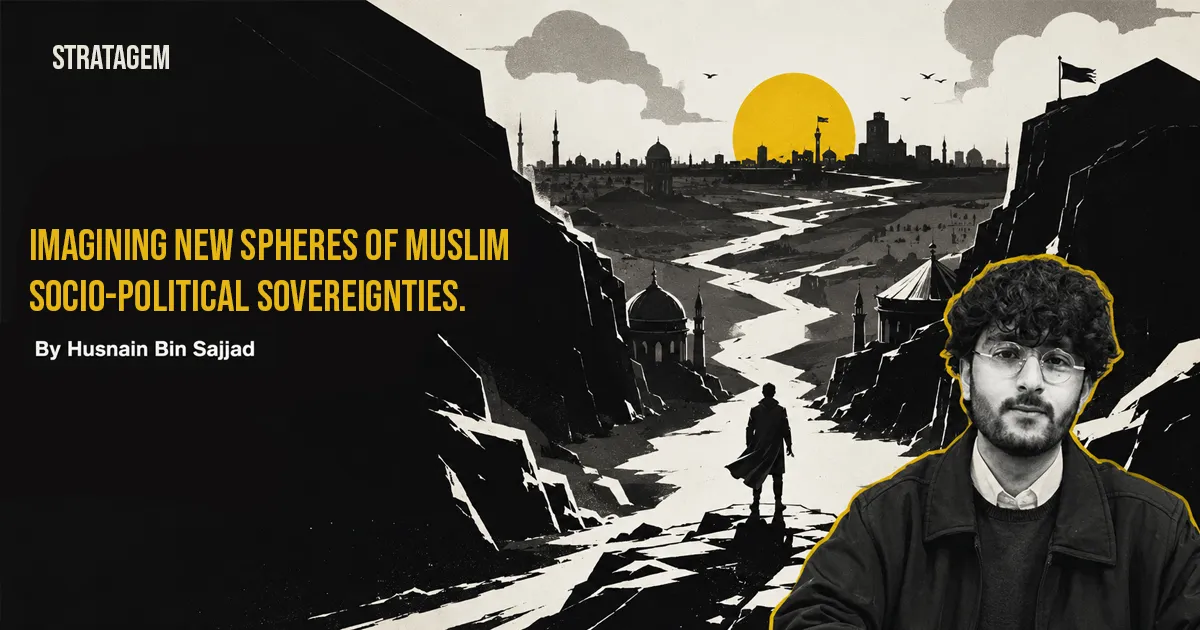
Imagining new spheres of muslim socio-political sovereignties
The discourse around the complete political nullification of the nation-state paradigm by alternating it with a wholly political “khilafati-united-global rule” needs to practically work currently within the modern structures of political governance, in order to negotiate some independence from atleast the hostile actors within the same political structures rather than to aim for the complete collapse for the the nation-state framework from the get go. The fundamental question therefore is not merely whether the modern state should be accepted or rejected, but how muslim political imagination can operate within existing realities while simultaneously transcending the ideological limitations imposed by those realities. A future-oriented approach requires engaging with current structures without allowing them to define the totality of muslim political aspirations. Caliphate today can only be practically envisioned as a cooperative-institutions within nation states rather than the complete erasure of the modern state structures, and a region-oriented multipolarity vis a vis a shared threat opens the perfect opportunity to encourage such cooperation by the governments, but with an ideologically sovereign and transnational identity. The problem is not necessarily the existence of political geography itself, but rather the elevation of geography into the primary source of collective belonging and political legitimacy. Territorial boundaries of countries can be assimilated into a transnational ummatic system of cooperative governances, if they remain geographical only and aren’t made to be ideological (which is difficult within the nation-state context as demonstrated by hallaq), khilafah as a communal ethico-social system doesn’t necessarily demand an abrupt and absolute eradication of state-territories, in fact maintaining them is beneficial for pragmatic administrative reasons. This distinction between territory and identity becomes central to the entire discussion. The problem is not necessarily the existence of political geography itself, but rather the elevation of geography into the primary source of collective belonging and political legitimacy. Once that distinction is made, a different model of political organisation becomes theoretically possible. The only demand from the nation-state paradigm here would be to strip away its identity construction hegemony based on ethnic or geographical markers and become complicit for a globalised muslim-hood as a priority in identity, while maintaining its administrative geographical hold within its territories, territory here becomes an object of governance only and not identity, identity becomes now an object of faith and subject of transnational cooperation as a priority. An emphasis has to be placed on the point of developing an “ideologically sovereign material institutionalism”. The only realistic conception of a unified muslim political system has to be envisioned in terms of soft power & transnational politico-economic cooperative institutionalism rather than through the zero-sum farfetched revolutionary logics which cannot feasibly move beyond literature, new websites and academic conferences. This shift from purely symbolic unity towards institutional capacity is where the discussion moves from political theory into practical civilisation building. A sovereign identity without sovereign mechanisms of production, education, technology and economic coordination remains vulnerable to the very systems it seeks to transcend. An emphasis has to be placed on the point of developing an “ideologically sovereign material institutionalism”. The crux of the collective muslim problems boils down to not having ideological sovereign material institutions of our own – where neither muslim metaphysical psyches are forced to operate through the material institutions and benchmarks constructed by the western ideological systems nor the muslim spiritio-philosophical orientations stay independent of material institutionalism for collective growth – neither mere ideological supremacy nor hollow imitation of the material infrastructure of the west would help us succeed in the world as muslims, the requirement here would be the development of well-connected techno-economic infrastructure throughout the muslim world working through muslim ummatic logics of priorities with a maturely balances between the ambitions of the ghayb and the temporal. The challenge, however, is that such institutional development cannot happen in an abstract political vacuum. Any attempt to construct alternative spheres of cooperation inevitably comes acroos the existing structures of power that regulate movement, communication, capital and social & communal organisation. Transnational cooperative institutionalism for educative and economic integration of the muslims between themselves are the urgent need of our times – and as odd and unpopular it might sound, this needs to be taken as a priority by the ethico-spiritual movements as well as muslim multinational cooperations (given their escape from capitalistic interests) who already have established transnational mobility networks throughout the muslim worlds – to build an economically and ideologically sound parallel sovereignty Another thing that definitely cannot be overlooked is the inevitable clash such a vision of developing a parallel sovereignty would have with the nation state and its insecurities regarding the grip it desires over its subjects. it’s particularly tricky and challenging to escape and construct an effective communal body (especially through techno-globalisation) independent of the nation-state mainly due to the hegemony it has established in surveillance technologies over its subjects. In pre-modern times, structures could collapse through sheer force and chaos, as the governing apparatus for the most part was material, tangible and apparent and therefore could be simpler in its operations for the laity could conceptualise, scheme against and overthrow. The difficulty of the modern condition is therefore not only political but also technological and epistemological. Power no longer operates merely through visible institutions; it increasingly exists through complex systems that shape behaviour, perception and possibilities before direct political confrontation even occurs. In pre-modern times, structures could collapse through sheer force and chaos. The difficulty of the modern condition is therefore not only political but also technological and epistemological. The problem as identified by Heidegger with modern technology is its complexity and invisibility in regards to its operations, becoming especially magically hegemonic within the nation-state functions of surveillance – which the masses cannot even comprehend let alone be able to plan a revolt against. Therefore, to construct a sovereign socio-politically effective body, throughout the muslim world, against the flow of nationstate’s insecure quasi-omniscient grip over identity control might require something way radically new if the transnational ideological sovereign techno-economic institutionalism. Husnayn Bin SajjadHusnayn Bin Sajjad is
Imagining new spheres of muslim socio-political sovereignties Read More »